This paper analyzes the national AI strategies of the Kingdom of Saudi Arabia (KSA) and the United Arab Emirates (UAE) through document analysis. It compares their key official documents and describes key components, priority sectors, similarities, differences, and national visions. The results show that both countries: 1) prioritize AI in resources, energy, and healthcare, among other sectors, but differ in economic diversity, data governance, and investment targets; 2) are well-equipped to become regional and global AI leaders; and 3) lack in the areas of skills gaps, regulatory frameworks, and global competitiveness. This work concludes with recommendations for policymakers, researchers, and industry stakeholders.
Keywords: document analysis, AI strategies, KSA, UAE.
I. INTRODUCTION
Recent trends in Artificial Intelligence (AI) are rapidly changing industries, economies, and societies worldwide. The research [7] shows “global GDP could be up to 14% higher in 2030 as a result of AI”. This shows how important AI is for shaping future prosperity. Furthermore, nations are harnessing the potential of AI and trying to develop and implement national AI strategies. In this context, the UAE and the KSA each have launched ambitious national strategies. Both countries want to position themselves as global hubs for AI innovation and implementation.
The UAE’s National AI Strategy 2031 [9] and KSA’s National Strategy for Data & AI [8] are the important components of their broader national visions—UAE Centennial 2071 [10] and Vision 2030 [12], respectively.
LITERATURE REVIEW
AI is proving to be a transformative force in the global economy. References [5] state that “Generative AI’s impact on productivity could add trillions of dollars in value to the global economy.” This immense economic potential has prompted governments worldwide to develop national AI strategies. The Organisation for Economic Co-operation and Development [6] reports that “many countries have announced national AI strategies and policy initiatives, which commonly aim to ensure a leadership position in AI.”
In the Middle East, the UAE and KSA have emerged as regional leaders in AI adoption, having announced their national AI strategies [9][8], respectively. These strategies demonstrate a dedication to using AI as a driving force for the economy, technology, and humanity. Existing studies on national AI strategies often focus on developed economies such as the US, China, and the European Union, where AI adoption is more advanced. Reference [4] noted that China, Canada, and Finland were the first countries to announce their national AI strategies (section 7.3 of the report).
The US National AI Initiative Act [11] emphasizes forming a national Artificial Intelligence advisory committee, directing the National Academies to study AI's impact on the workforce, and China’s Next Generation Artificial Intelligence Development Plan [13] aims to leverage China's strengths in AI to boost national competitiveness and improve public services. Similarly, the European Union’s AI Strategy focuses on ethical AI and human-centric approaches [2].
Despite increasing research on national AI strategies, there is a limited comparative analysis of AI strategies in the Middle East region, especially regarding KSA and UAE. This highlights the need for further examination of their AI initiatives. A recent online report has examined national AI strategies (NASs) in the Arab region and identified six key themes, including AI's role in economic growth, job creation, regional leadership, and potential risks such as job displacement and loss of control over AI [3]. Their work differs in scope and methodology from our work. References [3] describe a generic regional perspective, while our work presents a detailed but concise comparative examination of the UAE and KSA’s strategic AI documents. Our work also focuses on identifying the key components of national strategies, describing both similarities and differences, and showing alignment with broader national visions and priority sectors.
II. METHODOLOGY
Our work used a document analysis methodology [1] to systematically examine and interpret national AI strategy documents and to draw conclusions. This method includes reading and interpreting documents to extract meaningful data and also to identify emerging patterns.
A. Document Analysis Process
Document Selection: The two primary documents selected were: 1) The UAE National AI Strategy 2031 [9], and 2) the KSA National Strategy for Data & AI [8]. These were chosen based on their relevance as official, strategic-level documents of national AI priorities.
Initial Review: Documents were read to understand their structure and main focus areas.
Theme Identification and Coding: Recurring themes and strategic components were identified and manually coded. Key themes (components) identified included: vision, objectives, talent development, research and innovation, data governance, economic impact, and priority sectors.
Comparative Analysis: The analysis involved reviewing identified patterns and extracting relevant information on key themes or components (Table I). Furthermore, the comparative analysis highlighted similarities and differences based on key components.
Insights & Interpretation: This step provided insights into how each country is using AI to achieve national goals and address significant regional challenges.
B. Methodology Flowchart
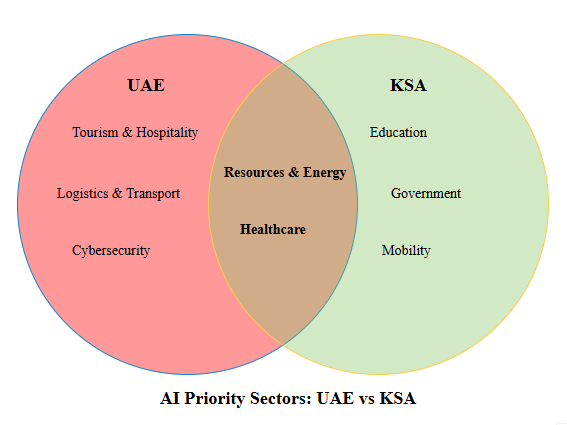
Figure 1: Flowchart of methodology.
III. RESULTS
The UAE National AI Strategy 2031 describes a clear vision to position the country as a global leader in AI by 2031 [9] (page 2). The strategy focuses on eight strategic objectives, with key priorities including building a reputation as an AI destination, increasing competitive assets, and ensuring strong governance. The strategy also emphasizes the importance of talent development, public AI training, upskilling students, and government training programs (objective 5) for a future-ready workforce.
It is also a priority for the UAE to focus on research and innovation. This is planned to be achieved by establishing a National Virtual AI Institute. Another important objective is to attract global AI researchers to build world-leading research capabilities. Data governance is another key focus area, aiming to create a secure data infrastructure (objective 7) and promote ethical and responsible AI practices (objective 1). The UAE estimates that AI could contribute AED 335 billion to its economy by 2031, with major focuses on different priority sectors (Figure 2). Finally, the strategy also highlights the importance of strong governance, regulations, collaboration, and ensuring responsible AI development (objective 8).
On the other hand, the KSA National Strategy for Data & AI [8] emphasizes positioning the Kingdom as a regional and global hub for Data & AI by 2030. Their key emphasis is on open data, talent development, and investment. Their strategy is aligned with KSA’s Vision 2030 [12] for economic diversification and considers “data as the new oil” [8] (Narrative, Section 3). An important feature of KSA’s AI strategy is its commitment to open data which they are planning to roll out across government entities after 2025 (Section 4.1). This may drive innovation and attract businesses especially those which rely on data for AI development.
Talent development (Section 4.1, and Objectives 2 & 3) is another key priority with the integration of AI into the education system (Section 4, Objective 2). This will further help to create specialized tracks and offer professional training to build a talented local workforce that will be skilled in Data & AI (Section 4, Objective 2). Their AI strategy also emphasizes the need for a regulatory environment by keeping in view ethical AI development and data protection. The strategy also highlights the importance of establishing innovation hubs and test-beds in smart cities like NEOM and promoting partnerships with global research institutions (Section 1.0). The KSA is aiming to attract 75 billion SAR in AI-related investments by 2030, which will be supported by targeted funds and investor support programs (Section 5.0).
Table I. Comparative Document Analysis of UAE and KSA National AI Strategies (Key Components)
| Key Components |
UAE National AI Strategy 2031 |
KSA National Strategy for Data & AI |
| Vision |
Become a global leader in AI by 2031. |
Become a global hub for Data & AI by 2030. |
| Alignment with National Vision |
UAE Centennial 2071. |
KSA Vision 2030. |
| Key Objectives |
1) Build a reputation as an AI destination; 2) Increase competitive assets; 3) Ensure strong governance. |
1) Position KSA as a worldwide hub for Data & AI; 2) Develop local talent; 3) Promote open data. |
| Talent Development |
Public AI training, upskilling students, and government training programs. |
Integrate AI into education, create specialized tracks, and offer professional training. |
| Research & Innovation |
Establish a National Virtual AI Institute and attract global researchers. |
Create innovation hubs and test-beds in smart cities like NEOM. |
| Data Governance |
Create a secure data infrastructure and promote ethical AI practices. |
Roll out open data by default across government entities by 2025. |
| Economic Impact |
AI could contribute AED 335 billion to the economy by 2031. |
Target attracting 75 billion SAR in AI-related investments by 2030. |
| Priority Sectors |
Energy, healthcare, tourism, logistics, cybersecurity. |
Energy, healthcare, mobility, education, government services. |
| Governance & Regulation |
National governance and international collaboration on AI ethics. |
Develop regulatory frameworks; focus on ethical AI development. |
| Key Similarities |
Both strategies focus on talent development, research and innovation, and governance; both align with broader national visions; both emphasize economic value; both prioritize Energy and Healthcare. |
| Key Differences |
Focus on building a global reputation and improving sectors like tourism, logistics, and cybersecurity. |
Emphasis on open data, investment, innovation, and economic diversification to reduce dependence on oil. |
Figure 2: AI Priority Sectors: UAE vs KSA.
IV. DISCUSSION AND CONCLUSION
The analysis of the strategies of both countries shows that they are committed to becoming global AI leaders, focusing on economic growth, research and innovation, and social development. This is crucial to build sustainable AI ecosystems. The focus of UAE’s strategy is on building a global reputation for AI with its emphasis on multiple sectors like tourism and logistics. Similarly, the emphasis of KSA’s AI strategy is on open data, investment, and innovation which describes its goal of becoming a hub for Data & AI by 2030.
However, both countries face significant challenges that should be addressed in order to fully realize the potential of their AI strategies. For example, the UAE’s reliance on global (expatriate) talent and KSA’s skill gaps are critical barriers that require initiatives for future-ready local workforces. Regulatory uncertainties and the need for policy frameworks are also important challenges. The intense global competition from established AI leaders such as the US, China, and the EU further requires extra effort on the path to global leadership in AI for both countries.
To overcome these challenges, both countries must advance international collaboration with a focus on local talent development, invest in research and innovation, and continuously update their AI strategies with respect to the latest technological advancements.
The analysis of key documents also provides important insights for policymakers, researchers, and industry stakeholders to effectively apply AI in the UAE and KSA (Table II).
Table II. Key Insights for Policymakers, Researchers, and Industry Stakeholders
| Stakeholder |
Key Insights |
| Policymakers |
1) Increase AI investments through incentives and local and global partnerships.
2) Create regulatory frameworks for ethical and responsible AI adoption.
3) Develop AI talent through education and international collaboration.
|
| Researchers |
1) Analyze the effectiveness of AI strategies.
2) Explore sector-specific AI adoption, especially research collaboration in priority sectors.
3) Investigate open data initiatives and ethical concerns.
|
| Industry Stakeholders |
1) Leverage AI strategies for business and investment opportunities in priority sectors.
2) Align AI initiatives with national priorities and ensure regulatory compliance.
3) Invest in AI workforce development to address talent shortages.
|
While no formal framework such as SWOT or PESTLE was applied in this initial analysis, the emergent themes offer a strong foundation for applying such frameworks in future research. For example, SWOT analysis could help evaluate the internal strengths and weaknesses of each strategy, alongside external opportunities and threats. Also, the PESTLE framework could guide a more macro-level analysis focusing on Political, Economic, Social, Technological, Legal, and Environmental factors influencing AI strategy development.
REFERENCES
[1] Bowen, G. A. (2009). Document analysis as a qualitative research method. Qualitative Research Journal, 9(2), 27–40. https://doi.org/10.3316/QRJ0902027
[2] European Commission. (2020). White paper on artificial intelligence: A European approach to excellence and trust. https://ec.europa.eu
[3] Hendawy, M., & Kumar, N. (2024). AI in the national AI strategies of the Arab region (Critical Policy Analysis 2021–2025, July 2024). Arab Reform Initiative. https://s3.eu-central-1.amazonaws.com/storage.arab-reform.net/ari/2024/11/13112245/2024-08-09-EN-Menna.pdf
[4] Maslej, N., Zhang, B., Barron, B., & Etchemendy, J. (2024). The AI Index 2024 Annual Report. Stanford University, Institute for Human-Centered AI. https://hai.stanford.edu/ai-index/2024-ai-index-report
[5] McKinsey & Company. (2021). The economic potential of generative AI: The next productivity frontier. https://www.mckinsey.com
[6] OECD. (2019). Artificial Intelligence in Society. OECD Publishing. https://doi.org/10.1787/eedfee77-en
[7] PwC. (2021). Sizing the prize: What’s the real value of AI for your business and how can you capitalise? https://www.pwc.com
[8] Saudi Data and Artificial Intelligence Authority (SDAIA). (2020). National Strategy for Data & AI: Strategy Narrative (October 2020). https://www.carringtonmalin.com/wp-content/uploads/2020/08/NDAIS-Strategy-Narrative-V2-19Oct20.pdf
[9] U.A.E. Government. (2018). UAE National Strategy for Artificial Intelligence 2031. https://ai.gov.ae/wp-content/uploads/2021/07/UAE-National-Strategy-for-Artificial-Intelligence-2031.pdf
[10] U.A.E. Government. (2023). UAE Centennial 2071. https://u.ae/en/about-the-uae/strategies-initiatives-and-awards/strategies-plans-and-visions/innovation-and-future-shaping/uae-centennial-2071
[11] United States Congress. (2020). National Artificial Intelligence Initiative Act of 2020. https://www.congress.gov/bill/116th-congress/house-bill/6216/text
[12] Vision 2030 Kingdom of Saudi Arabia. (2016). KSA Vision 2030. https://www.vision2030.gov.sa/media/rc0b5oy1/saudi_vision203.pdf
[13] Xinhua News Agency. (2017). China’s Next Generation Artificial Intelligence Development Plan. http://fi.china-embassy.gov.cn/eng/kxjs/201710/P020210628714286134479.pdf