• May 21 - 22, 2025
  • ADSM, Abu Dhabi

ICAIMT Proceedings

#ICAIMT2025

International Conference on Artificial Intelligence Management and Trends

Conference Date: May 21, 2025

Abu Dhabi School of Management (ADSM), Abu Dhabi

Article

Reframing UTAUT for Mandatory Public AI Services: A Case from Abu Dhabi, UAE

Muneera Ali Alsulaimani - Department of Information Systems and Technology Management - Zayed University - Abu Dhabi, UAE - M80008969@zu.ac.ae - Maher Alaraj - Department of Information Systems and Technology Management - Zayed University - Dubai, UAE - maher.alarah@zu.ac.ae - Abdulla Naqi - Department of Information Systems and Technology Management - Zayed University - Dubai, UAE - Abdulla.Naqi@zu.ac.ae
Published: 01 Sep 2025 https://doi.org/10.63962/YOHW5251
PDF downloadable

Abstract

Artificial Intelligence (AI) is transforming public service delivery in the UAE, exemplified by Abu Dhabi’s TAMM platform. This study employs an extended Unified Theory of Acceptance and Use of Technology (UTAUT) framework, substituting Behavioral Intention with User Satisfaction to reflect mandatory-use contexts. Using a sequential explanatory mixed-methods approach, the research collected survey responses from 137 TAMM users and conducted follow-up interviews. Key findings show that Effort Expectancy, Facilitating Conditions, and Social Influence significantly influence satisfaction; moderating effects of gender and AI experience were also observed. The study offers theoretical extensions to UTAUT and strategic recommendations aligned with the UAE Digital Government Strategy 2025–2027.

Keywords: AI adoption, user satisfaction, UTAUT, government platforms, Abu Dhabi, TAMM, SmartPLS, trust
I. INTRODUCTION
The adoption of AI by public organizations is reshaping government service delivery worldwide. In Abu Dhabi, the TAMM platform integrates AI-driven features to enhance citizen interactions, supporting ambitions to become the first fully AI-powered government by 2027 under initiatives such as the Artificial Intelligence and Advanced Technology Council and the Digital Government Strategy 2025–2027. Despite these ambitions, success depends on public satisfaction and acceptance—especially in mandatory-use platforms where opting out is not feasible.

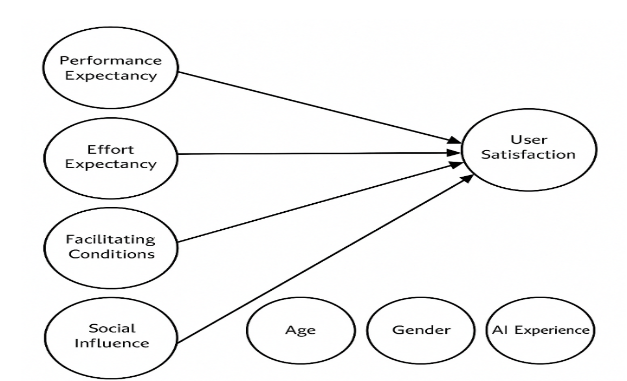
This study extends the UTAUT model by substituting Behavioral Intention with User Satisfaction and examines how Performance Expectancy (PE), Effort Expectancy (EE), Social Influence (SI), and Facilitating Conditions (FC) shape satisfaction with AI features on TAMM. It also explores moderation by age, gender, and prior AI experience.

Hypotheses: H1 (PE→Satisfaction), H2 (EE→Satisfaction), H3 (SI→Satisfaction), H4 (FC→Satisfaction), H5 (User Experience→Satisfaction).

Figure 1: Research Model used in the study
II. METHODOLOGY
A sequential explanatory mixed-methods approach was adopted. In Phase 1, a quantitative survey was administered online to 137 TAMM users with experience of AI features. Items measured UTAUT constructs (PE, EE, SI, FC) and User Satisfaction on a 5-point Likert scale (1 = strongly disagree, 5 = strongly agree).

In Phase 2, semi-structured interviews were conducted with three TAMM stakeholders (senior government employee, policymaker, IT implementer) to contextualize quantitative results. Thematic analysis was employed given its flexibility, with interview scripts analyzed to extract themes; outputs from a large language model were reviewed and edited, then mapped to UTAUT constructs and hypotheses. Ethical approval was obtained from Zayed University’s Ethics Committee; all participants gave informed consent and responses were anonymized.
III. RESULTS AND KEY INSIGHTS
Quantitative findings. Path estimates indicated that EE (β = 0.252, p = 0.003), FC (β = 0.304, p < 0.001), and SI (β = 0.176, p = 0.029) significantly influenced User Satisfaction, whereas PE (β = 0.135, p = 0.112) did not. The model explained 48.2% of the variance in satisfaction (R² = 0.482).

Table 1. Path Coefficients and Significance
Path Original sample (O) Sample mean (M) P values
EE → UES10.2520.2520.003
FC → UES10.3040.3110.000
PE → UES10.1350.1330.112
SI → UES10.1760.1740.029

Moderation and qualitative insights. Multi-group and interaction-term analyses suggested significant moderation by gender and AI experience: FC effects were stronger among female users; SI effects were stronger among users without prior AI experience; age showed no significant effects. Interview themes emphasized trust, usability, hybrid human–AI interaction, multichannel access, support infrastructure, and ethical AI governance.

Table 2. Thematic Analysis
Theme UTAUT Construct Related RQ / Hypothesis Outcome
AI enhances government efficiencyPerformance ExpectancyH1Supported
Usability & multichannel designEffort ExpectancyH2Supported
Training and supportFacilitating ConditionsH3Supported
Managerial and peer influenceSocial InfluenceH4Partially supported
Hybrid use and trustUser SatisfactionH5Supported
Ethical AI governanceTrust (Emergent)—Emergent
IV. CONCLUSION
A. Summarize Findings. EE and FC were the strongest drivers of satisfaction; SI had a smaller yet significant effect; PE was not significant. Qualitative evidence reinforced the importance of usability, training/support, and trust.

B. Key Contributions. Theoretical: Positions User Satisfaction as a key outcome in UTAUT for compulsory public-service contexts and highlights the role of trust/transparency. Practical: Underscores design priorities—usability, support infrastructure, multichannel access, and ethical governance. Methodological: Demonstrates value of mixed methods for public-sector AI evaluation.

C. Future Direction. (1) Longitudinal studies to track shifts in perceptions as systems mature; (2) Cross-country comparisons to distinguish universal vs. culture-specific adoption factors; (3) Deeper analysis of trust in technology vs. trust in government deployment; (4) Experiments on human–AI division of labor in service delivery.

REFERENCES

[1] Y. K. Dwivedi, L. Hughes, E. Ismagilova, et al., “Artificial intelligence (AI): Multidisciplinary perspectives on emerging challenges, opportunities, and agenda for research, practice and policy,” International Journal of Information Management, vol. 57, p. 101994, 2021.

[2] K. Alhosani and S. M. Alhashmi, “Opportunities, challenges, and benefits of AI innovation in government services: A review,” Discover Artificial Intelligence, vol. 4, no. 18, 2024.

[3] Abu Dhabi Media Office, “Abu Dhabi Government launches Digital Strategy 2025–2027,” 2025.

[4] M. Alshehri, S. Drew, and T. Alhussain, “Mandatory technology adoption in government: A UAE case study,” Government Information Quarterly, vol. 40, no. 1, p. 101763, 2023.

[5] S. Alsheibani, Y. Cheung, and C. Messom, “Artificial intelligence adoption: AI-readiness at firm-level,” PACIS 2018 Proceedings, p. 198, 2018.

[6] V. Venkatesh, M. G. Morris, G. B. Davis, and F. D. Davis, “User acceptance of information technology: Toward a unified view,” MIS Quarterly, vol. 27, no. 3, pp. 425–478, 2003.

[7] J. W. Creswell and V. L. P. Clark, Designing and Conducting Mixed Methods Research, 3rd ed., SAGE, 2018.

[8] J. F. Hair, C. M. Ringle, and M. Sarstedt, “Partial least squares structural equation modeling,” in Handbook of Market Research, Springer, 2017, pp. 1–40.

[9] V. Braun and V. Clarke, “Using thematic analysis in psychology,” Qualitative Research in Psychology, vol. 3, no. 2, pp. 77–101, 2006.

[10] S. Farber, “Comparing human and AI expertise in academic peer review: Towards a hybrid approach,” Higher Education Research & Development, 2025.

[11] S. Vaithilingam, S. K. Raj, and K. Paulraj, “The role of large language models in qualitative research: Opportunities and challenges,” AI & Society, 2022.

[12] R. Medaglia, J. R. Gil-Garcia, and T. A. Pardo, “Artificial intelligence in government: Taking stock and moving forward,” Social Science Computer Review, vol. 41, no. 1, pp. 123–140, 2023.

[13] N. P. Rana, S. Chatterjee, Y. K. Dwivedi, and S. Akter, “Understanding dark side of artificial intelligence (AI) integrated business analytics: Assessing firm's operational inefficiency and competitiveness,” European Journal of Information Systems, 32(2), 364–387, 2023. 10.1080/0960085X.2021.1955628

[14] V. Venkatesh, T. Sykes, and X. Zhang, “‘Enterprise AI’: Advancing digital transformation research,” MIS Quarterly, 46(3), pp. iii–xxii, 2022.