Article
AI-Based Framework for Forecasting Defense Technologies in Defense Acquisition
The quick pace of technological innovation and evolving global threats pose challenges to defense acquisition. The traditional forecasting methods lack the agility to support the forecasting of rapid technology developments. This research presents a conceptual AI-driven framework developed to enhance defense technologies forecasting, thereby improving defense acquisition processes. The conceptual framework integrates open-source (OSINT) and internal data with artificial intelligence (AI) techniques, including machine learning, natural language processing (NLP), and unsupervised clustering; the framework identifies emerging technologies, evaluates Technology Readiness Levels (TRLs), and visualizes insights, developed through literature review and validated by defense and AI experts; the framework supports scenario-based forecasting and human-in-the-loop. This research aims to contribute an adaptive model capable of enhancing technology forecasting, reducing acquisition risks and costs, and aligning future technological needs with threats.
Keywords: Defense Acquisition, Technology Forecasting, Artificial Intelligence, Big Data, Machine Learning, Natural Language Processing, Technology Readiness Levels, OSINT, Predictive Analytics
I. INTRODUCTION
Defense acquisition is a complex and lengthy process, often challenged by inefficiencies and the risk of acquiring costly or outdated technologies [1]. Artificial Intelligence (AI) and Big Data can play a major role in improving this process by offering better insights, enhanced forecasting, and integrating different data sources [2]. It is important to note that defense acquisition involves much more than procurement, including identifying needs, planning, development, testing, deployment, and sustainment. Acquisition programs aim to deliver new or improved military capabilities, covering weapons, IT systems, and support services essential for national defense.
Defense acquisition struggles to keep up with rapid technological change due to slow data analysis, fragmented systems, and outdated forecasting methods. There's a lack of AI-driven frameworks tailored to defense needs, leading to poor predictions, costly mistakes, and reduced readiness [3-4]. Integrating AI and Big Data is a must through ensuring performance, transparency, and proper model use.
This research is driven by the need to use AI and Big Data to improve defense technology forecasting. Early and continuous integration of AI offers real-time insights into emerging technologies, helping decision-makers plan, detect outdated capabilities, and assess readiness. AI tools like predictive analytics and clustering support better decision-making under pressure and improve situational awareness by merging data from different sources. The developed framework aims to enhance acquisition outcomes and operational readiness. It contributes to academic knowledge and helps policymakers align technology planning with future defense needs [4-5].
The aim of the research is to develop a conceptual AI-driven framework for forecasting defense technologies using Big Data. It explores challenges in the acquisition process, designs and validates the framework with experts’ input, and addresses ethical and social considerations. The paper reports the relevant literature review, the methodology used in the research, data analysis, findings, discussion and conclusion.
II. LITERATURE REVIEW
The reviewed literature confirms the growing importance of AI and Big Data in enhancing defense technology forecasting. Studies like Agrawal et al. [5] and Almahmoud et al. [6] show how AI supports better decision-making and cyber threat prediction. Autio et al. [7] and Cummings [8] emphasize ethical and technical limitations, while others like Ebadi et al. [9] and De Spiegeleire et al. [10] demonstrate AI’s use in detecting emerging technologies and improving strategic agility, especially in smaller states. Defense-focused studies like GAO [4], Kott & Perconti [3], and Morgan et al. [11] stress the need for structured AI frameworks and policies in defense acquisition. Research by Kania [12], and MIT AI Accelerator [13] highlights global competition and the urgency of adopting AI across operations. RAND’s reports [14] and frameworks offer insights on technology evaluation and innovation planning. The literature supports that AI-driven forecasting tools can offer valuable insights into defense acquisition, but success depends on proper integration, data readiness, human oversight, and policy alignment.
III. METHODOLOGY
The research methodology implemented in this work was intended to explore how AI and Big Data can be integrated into defense technology forecasting. Ethical approval was obtained from the ADSM ethical committee, ensuring the research is aligned with academic and ethical standards. The process started with a literature review to understand current challenges in defense acquisition and how AI can support in overcoming them. Based on the insights gathered from the literature review only, the initial conceptual framework was developed.
Afterwards, the framework was validated by four experts in the area of defense and AI. Consent from participants was obtained as part of the requirement of the research. Due to the sensitivity of the topic, it is important and ethically required to declare that the research examines only public information as published reports and articles and maintains ethical standards of handling expert insights. This research did not involve any primary data collection. The analysis presented in the Data Analysis section is based on existing literature. The validation input from experts is handled with strict confidentiality with protection, and limiting access to authorized researchers only.
Industry experts were asked whether the framework addresses key pain points in defense acquisition and if the alliance and non-alliance countries analysis of technology adoption is relevant and useful for strategic planning. They evaluated whether the dashboard provides enough detail to inform acquisition decisions, and how well the alliance technology analysis supports collaboration and co-development. Experts also gave feedback on the reliability of the data sources used, whether the framework captures emerging disruptive technologies or leaves gaps, and what additional data or features could improve the dashboard’s usefulness. Questions included how often the dashboard should be updated to reflect real-time trends, whether it helps anticipate future needs and align acquisition accordingly, and if they would prefer using this dashboard over current tools—and why.
The interview questions for AI experts focused on evaluating the technical capabilities of the proposed framework. Experts were asked whether the AI models could identify trends, competitor technologies, and alliance capabilities, and if the natural language processing (NLP) components were effective in extracting insights from unstructured data like reports and articles. They assessed whether the time-series forecasting models were suitable for predicting long-term technology trends and if the system effectively integrates multiple data sources to provide unified and accurate forecasts. Questions also covered the usefulness of clustering and predictive analytics, the framework’s ability to detect emerging technologies and historical patterns, and whether data integration and preprocessing were sufficient to ensure accurate dashboard outputs. Experts were asked to comment on the framework’s scalability, potential technical limitations, the role of feedback loops in improving prediction accuracy, and suggestions for adaptive learning mechanisms or overall improvements.
Experts’ recommendations were later used to finalize the conceptual framework to address gaps and improve functionality that reflect real-world industry needs.
IV. DATA ANALYSIS
This section focuses on analyzing the different tools and components used to build the AI-driven defense technology forecasting framework through existing literature, exploring and justifying the use of tools in each layer of the framework. The research highlights the importance of extracting data from different sources. Publicly available sources like OSINT, news, and defense reports, as well as internal datasets, can be extracted using a combination of web scraping, NLP tools, and APIs [15]. LLMs like GPT and Claude were also mentioned to help extract key insights from research and technical documents [16]. For storage, a hybrid model combining cloud and physical storage was considered [17]. Tools like Apache Kafka and Flume ingest large volumes of data, while PostgreSQL and MongoDB handle structured and unstructured information securely [18-19].
Data preparation involved cleaning and structuring data using Pandas, spaCy, and NLTK to remove noise and standardize formats. NLP tasks like NER, tokenization, and topic modeling identify defense technologies, organizations, and geopolitical players [20]. For the analytics layer, AI tools detect trends and forecast technologies. This included clustering (K-Means), topic modeling (LDA), and forecasting methods like ARIMA, Prophet, and LSTM [21]. Tools like Monte Carlo and Bayesian Networks help assess risk and uncertainty, while classification models like BERT and XGBoost can support TRL prediction [22]. The visualization layer can use tools like Tableau and Power BI to present findings—heatmaps, graphs, and dashboards—helping decision-makers understand patterns and risks. Tools like Gephi and D3.js allow relationship mapping across technologies and actors [23].
V. THE PROPOSED FRAMEWORK
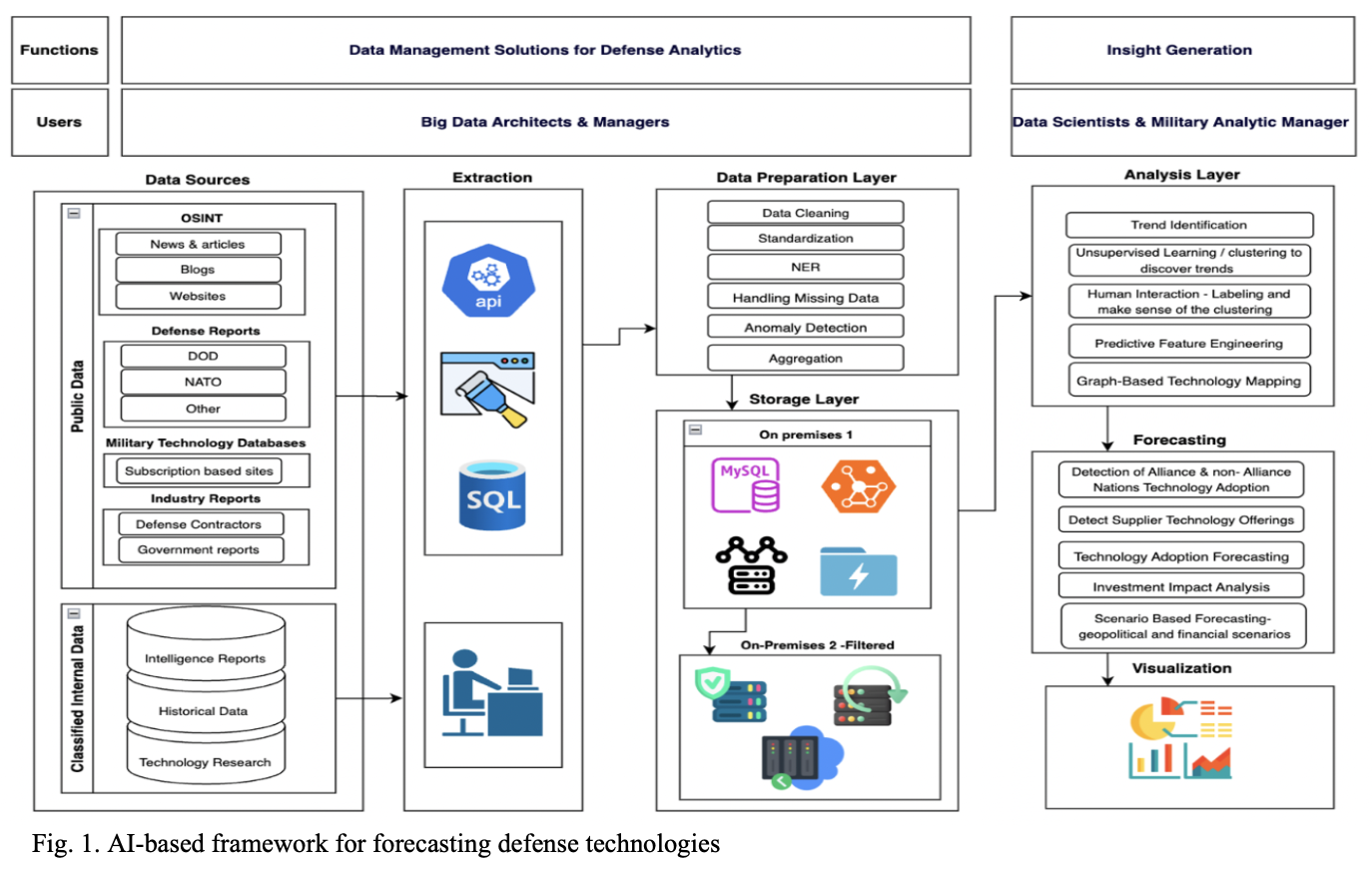
According to the information gathered from the requirement analysis phase, the initial framework was designed as a structured, AI-driven system to support defense acquisition by forecasting technologies through a multi-layered architecture. It included key layers: data sources, extraction, data preparation, storage, analysis, forecasting, and visualization. It relied on integrating OSINT and classified defense data, using AI techniques like NLP, clustering, and trend detection to identify and visualize emerging technologies.
After evaluations by AI experts, the framework also introduced classification of internal data, added missing-data handling and anomaly detection, and incorporated Technology Readiness Level (TRL) standardization. Human-in-the-loop mechanisms, physical storage only, graph-based mapping, predictive feature engineering, and scenario simulations were also included to improve accuracy, interpretation, and adaptability (Fig. 1).
VI. DISCUSSION
From the validation sessions conducted with AI and industry experts, they agreed that the framework effectively addresses key challenges in defense acquisition and effectively forecasts technologies using AI and Big Data. They confirmed the framework’s strength in identifying trends, competitor technologies, and alliance capabilities, supported by NLP, time-series forecasting, and data integration from OSINT and classified sources. Experts emphasized the importance of human-in-the-loop mechanisms to guide AI outputs and reduce reliance on automation. Recommended improvements included semi-supervised learning, anomaly detection, fairness tools, continuous model retraining, and incorporating Technology Readiness Levels (TRLs). While the framework is scalable and adaptive, ongoing challenges include data integrity, classification limits, and bureaucratic barriers.
Compared to traditional models, this approach is more proactive—leveraging real-time analytics, unstructured data, and geopolitical context to anticipate emerging threats and guide acquisition planning more effectively.
A. Limitations
Several limitations were noted during validation. The framework heavily relies on OSINT and public sources. The use of unsupervised learning helps identify patterns but lacks clarity without expert input. To improve accuracy, semi-supervised and active learning, bringing defense experts into the loop, are recommended. The framework also does not yet adapt to fast-changing geopolitical shifts, which affect technology needs. Integrating AI-based scenario simulations and conflict modeling would address this. Additional enhancements include business-intelligence features like contractor performance tracking, cybersecurity compliance, and supplier risk scoring. While anomaly detection is in place for procurement and R&D trends, it could be strengthened through federated learning, enabling secure, decentralized data sharing and improved scalability.
B. Future Work
The framework offers strong potential for improving defense acquisition, alliance planning, and risk assessment. Due to current limitations in the framework, future work could focus on adding semi-supervised learning, AI-driven scenario planning, and enhanced dashboards with BI features. Additional research could also focus on:
- Agentic framework for more autonomous AI forecasting
- Integration of classified and real-time intelligence feeds
- Multimodal AI combining text, imagery, sensors, & video
- Federated adaptive learning for secure, ongoing updates
- AI-powered scenario simulations to support forecasting
- Ethical frameworks and governance for AI in defense
- Expanded human interference
VII. CONCLUSION
This research introduced a conceptual AI-driven framework to improve defense technology forecasting by integrating AI, Big Data, and expert input. The conceptual framework enhances acquisition planning by combining structured and unstructured data, using tools like NLP, clustering, TRL assessments, and predictive analytics. Expert validation confirmed the importance of human oversight and continued learning, semi-supervised learning, and ethical AI use. Policy alignment of AI use with national security laws, ensuring compliance with international arms control agreements, preventing bias or unfair advantages to certain contractors, data security, and geopolitical forecasting are essential for real-world application. Future work should explore real-time data integration, agentic frameworks, federated learning, and immersive AR/VR dashboards. The framework sets a foundation for smarter, adaptive forecasting in defense acquisition.
REFERENCES
[1] Rieksts, B. Q., & Guerrera, K. M. A feasibility study on the use of artificial intelligence for defense acquisition program review, Volume I: Main Report. Institute for Defense Analyses, 2020. [Online]. Available: https://www.ida.org/-/media/feature/publications/a/af/a-feasibility-study-on-the-use-of-ai-for-defense-acquisition-program-review-volume-1-main-report/p-13239_vol1.ashx
[2] Barlow, C., Forbes, K., Giachinta, R., Levenson, Z., Novak, R., Raines, J., & Roe, S. Enhancing acquisition outcomes through leveraging artificial intelligence. MITRE Corporation (PR-24-0962-Leveraging-AI-in-Acquisition), 2024, pp. ii–26. [Online]. Available: https://www.mitre.org/sites/default/files/2025-03/PR-24-0962-Leveraging-AI-Acquisition.pdf
[3] Kott, A., & Perconti, P. Long-term forecasts of military technologies for a 20–30-year horizon: An empirical assessment of accuracy. Defense Technology Journal, Vol 7, Issue 3, pp. 112–134, 2020. DOI: 10.48550/arXiv.1807.08339
[4] United States Government Accountability Office (GAO). Artificial intelligence: Status of developing and acquiring capabilities for weapon systems, pp. 10–25, 2022. [Online] Available: https://www.gao.gov/products/gao-22-104765
[5] Agrawal, A., Gans, J. S., & Goldfarb, A. Economic perspective on artificial intelligence as a prediction technology. Journal of Economic Perspectives, Vol 33, Issue 2, pp. 31–50, 2019. DOI: 10.1257/jep.33.2.31
[6] Almahmoud, Z., Yoo, P. D., & Alhussein, O. A holistic and proactive approach to forecasting cyber threats. Scientific Reports, Vol 13, Article 7965, 2023. DOI: 10.1038/s41598-023-35198-1
[7] Autio, T., Jantunen, E., & Koskinen, H. AI in predicting technological trends for military operations. Journal of Emerging Defense Technologies, Vol 12, Issue 4, pp. 87–105, 2023. [Online] Available: https://files.thegovlab.org/a-snapshot-of-ai-procurement-challenges-june2023.pdf
[8] Cummings, M. Artificial intelligence and the future of warfare. Chatham House, 2017. [Online] Available: https://www.chathamhouse.org/sites/default/files/publications/research/2017-01-26-artificial-intelligence-future-warfare-cummings.pdf
[9] Ebadi, A., Auger, A., & Gauthier, Y. Detecting emerging technologies and their evolution using deep learning and weak signal analysis, pp. 1–17, 2025. DOI: 10.48550/arXiv.2205.05449
[10] De Spiegeleire, S., Maas, M., & Sweijs, T. Artificial intelligence and the future of defense: Strategic implications for small- and medium-sized force providers. The Hague Centre for Strategic Studies, 2017. [Online] Available: https://hcss.nl/report/artificial-intelligence-and-the-future-of-defense/
[11] Morgan, F. E., Boudreaux, B., Lohn, A. J., Ashby, M., Curriden, C., Klima, K., & Grossman, D. AI and national security: Policy considerations and technological advancements. RAND Corporation, 2020. [Online] Available: https://www.rand.org/pubs/research_reports/RR4280.html
[12] Kania, E. B. AI weapons and the implications for future warfare. Brookings Institution, 2020. [Online] Available: https://www.brookings.edu/wp-content/uploads/2020/04/FP_20200427_ai_weapons_kania_v2.pdf
[13] MIT AI Accelerator. Harnessing artificial intelligence for defense. Massachusetts Institute of Technology, 2022. [Online] Available: https://aia.mit.edu/wp-content/uploads/2022/02/AI-Acquisition-Guidebook_CAO-14-Feb-2022.pdf
[14] Wong, J. P., Younossi, O., LaCoste, C. K., Anton, P. S., Vick, A. J., Weichenberg, G., & Whitmore, T. C. Improving Defense Acquisition: Insights from Three Decades of RAND Research. RAND Corporation, 2022. [Online] Available: https://www.rand.org/pubs/research_reports/RRA1670-1.html
[15] Berghel, H. Robert David Steele on OSINT. Computer, Vol 47, Issue 7, pp. 76-81, 2014. DOI: 10.1109/MC.2014.191
[16] Gartlehner, G., Kahwati, L., Hilscher, R., Thomas, I., Kugley, S., Crotty, K., & Chew, R. Data extraction for evidence synthesis using a large language model: A proof-of-concept study. Research Synthesis Methods, Vol 15, Issue 4, pp. 576-589, 2024. DOI: 10.1002/jrsm.1710
[17] Sohal, M., Bharany, S., Sharma, S., Maashi, M. S., & Aljebreen, M. A hybrid multi-cloud framework using the IBBE key management system for securing data storage. Sustainability, Vol 14, Issue 20, 13561, 2022. DOI: 10.3390/su142013561
[18] Rani, S. Tools and techniques for real-time data processing: A review. International Journal of Science and Research Archive, Vol 14, Issue 1, pp. 1872-1881, 2025. DOI: 10.30574/ijsra.2025.14.1.0252
[19] Devlin, J., Chang, M. W., Lee, K., & Toutanova, K. BERT: Pre-training of deep bidirectional transformers for language understanding. In Proceedings of the 2019 Conference of the North American Chapter of the Association for Computational Linguistics: Human Language Technologies, Vol 1, pp. 4171–4186, 2019. DOI: 10.18653/v1/N19-1423
[20] Liu, Y., Ott, M., Goyal, N., Du, J., Joshi, M., Chen, D., Levy, O., Lewis, M., Zettlemoyer, L., & Stoyanov, V. RoBERTa: A robustly optimized BERT pretraining approach. arXiv, 2019. DOI: 10.48550/arXiv.1907.11692
[21] Jain, A. K. Data clustering: 50 years beyond K-means. Pattern Recognition Letters, Vol 31, Issue 8, pp. 651–666, 2010. DOI: 10.1016/j.patrec.2009.09.011
[22] Chen, T., & Guestrin, C. XGBoost: A scalable tree boosting system. In Proceedings of the 22nd ACM SIGKDD International Conference on Knowledge Discovery and Data Mining, pp. 785–794, 2016. DOI: 10.1145/2939672.2939785
[23] Newman, M. E. J. Networks: An introduction. Oxford University Press, 2010. [Online] Available: https://www.cs.cornell.edu/home/kleinber/networks-book/networks-book-ch03.pdf