I. INTRODUCTION
A. The Growing Need for AI Governance
Recent advancements in generative artificial intelligence (AI) have significantly boosted automation, data-driven decisions, and operational efficiency across sectors. Organizations are racing to adopt generative AI to stay competitive. However, this rapid integration demands robust governance frameworks to ensure ethical, secure, and regulation-compliant deployment [1,2]. As AI grows more complex, governance must address ethical risks, data security, regulatory adherence, and long-term sustainability.
- Addressing Ethical and Societal Challenges: AI systems trained on historical data can perpetuate discrimination in recruitment, lending, or law enforcement. Ensuring fairness, transparency, and accountability is essential for mitigating prejudice and promoting ethical AI use [3,4].
- Ensuring Data Privacy and Security: AI systems handling sensitive data are vulnerable to cyberattacks. Governance frameworks aligned with ISO 42001, along with encryption and strict access controls, help mitigate these threats and maintain compliance with laws like GDPR and the EU AI Act [5].
- Navigating the Regulatory Landscape: Governments are introducing AI regulations to enforce transparency and accountability. ISO 42001 offers a standardized approach to AI governance, helping organizations comply with emerging laws while fostering public trust [6].
- Improving Transparency and Risk Management: Opaque AI models (“black boxes”) limit stakeholders’ understanding of decisions. Incorporating Explainable AI (XAI) and conducting regular risk assessments enhances transparency and identifies vulnerabilities early [7,8].
Robust AI governance is a strategic necessity. Adopting frameworks like ISO 42001 enables organizations to embed ethics, compliance, and sustainability into AI systems—safeguarding operations and building long-term trust.
B. Role of ISO 42001 in AI Management
ISO 42001 is becoming a foundational standard for managing AI responsibly across the entire lifecycle—from design to continuous improvement. It promotes ethical, transparent, and accountable practices while ensuring robust risk management and organizational integration. Key components include leadership, planning, operation, performance evaluation, and continuous improvement. A central focus is comprehensive risk assessment and systematic monitoring of dynamic machine learning models, with an emphasis on XAI to reinforce stakeholder trust [9–14].
C. NEXUS: A Framework for Enterprise AI Hubs
NEXUS enables enterprises to integrate AI while aligning innovation with strategic goals. It embeds governance, risk management, and ethical best practices across five phases:
Navigate (strategic assessment and roadmap),
Establish (secure, scalable infrastructure and data governance),
eXecute (deployment and monitoring with bias, performance, and accountability controls),
Upskill (workforce AI literacy and mentorship), and
Sustain (audits, risk assessments, and oversight via governance committees) [15–19].
II. METHODOLOGY
This study adopts a theoretical approach to develop a conceptual governance framework integrating ISO 42001 with the NEXUS methodology. We synthesize best practices from literature on AI governance, risk management, ethical deployment, and international standards, then map them onto the five NEXUS phases (Navigate, Establish, eXecute, Upskill, Sustain) to propose an enterprise-ready conceptual model. No empirical data collection or validation is included; the framework offers a structured foundation to guide future implementation and research.
III. NEXUS + ISO 42001: AN INTEGRATED FRAMEWORK
Fig. 1. NEXUS + ISO 42001: An Integrated Conceptual Framework.
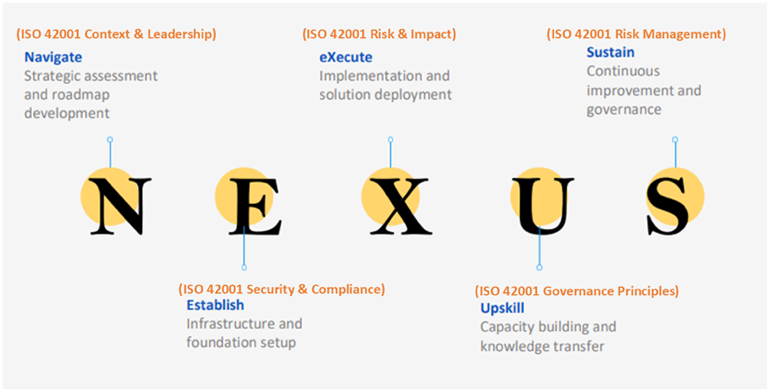 A. Strategic Assessment (Navigate + Context & Leadership from ISO 42001)
Align AI governance with business strategy via readiness assessment (infrastructure, skills, data policies), prioritized use cases, and a clear roadmap. Leadership sets goals, ethics, and oversight (governance committees, AI ethics officers), and risk planning addresses bias, security, and regulatory issues [20–22].
B. Infrastructure Setup (Establish + Compliance & Security from ISO 42001)
Build secure, scalable environments (HPC, cloud) with robust data governance. Ensure compliant AI stacks, secure API integrations, encryption, access control, privacy-enhancing technologies, and continuous monitoring, auditing, and vulnerability testing [23,24].
C. Solution Deployment (eXecute + ISO 42001 Risk & Impact Assessment)
Integrate AI models into enterprise systems with continuous monitoring and validation to detect anomalies, biases, and unintended impacts. Conduct risk assessments (fairness checks, vulnerability reviews), adopt XAI for transparency, and apply rigorous pre-deployment testing (stress tests, bias audits, scenario simulations) with feedback loops [25–27].
D. Upskilling & Workforce Training (Upskill + ISO AI Awareness)
Define role-based competency frameworks and deliver training on AI literacy, ethics, and regulatory compliance. Use hands-on simulations and case studies; promote continuous learning via mentorship, certifications, and academic partnerships [28–30].
E. Sustained Governance (Sustain + ISO 42001 Continuous Improvement)
Establish cross-functional governance committees; implement audit and compliance protocols for performance, privacy, and risk; continuously monitor bias and errors; and maintain stakeholder feedback loops to align systems with business goals and societal expectations [31–33].
IV. CONCLUSION
Integrating the NEXUS methodology with ISO 42001 provides a structured pathway for responsible AI in enterprises—covering strategic assessment, secure infrastructure, solution deployment, workforce development, and sustained governance. This conceptual model reinforces ethical practice, risk mitigation, and operational excellence, and offers a foundation for future research into scalability, industry specificity, and cultural impact.
REFERENCES
[1] G. P. Selvarajan, “Leveraging AI-enhanced analytics for industry-specific optimization: A strategic approach to transforming data-driven decision-making,” Int. J. Enhanc. Res. Manag. Comput. Appl., 10(10), 78–84, 2021.
[2] M. S. H. Mrida, M. A. Rahman, and M. S. Alam, “AI-driven data analytics and automation: A systematic literature review of industry applications,” Strateg. Data Manag. Innov., 2(1), 21–40, 2025.
[3] L. Floridi et al., “AI4People—An ethical framework for a good AI society: Opportunities, risks, principles, and recommendations,” Minds Mach., 28, 689–707, 2018.
[4] A. Jobin, M. Ienca, and E. Vayena, “The global landscape of AI ethics guidelines,” Nat. Mach. Intell., 1(9), 389–399, 2019.
[5] A. H. Salem, S. M. Azzam, O. E. Emam, and A. A. Abohany, “Advancing cybersecurity: A comprehensive review of AI-driven detection techniques,” J. Big Data, 11(1), 2024.
[6] D. Lewis, D. Filip, and H. J. Pandit, “An ontology for standardising trustworthy AI,” IntechOpen eBooks, 2021.
[7] G. Banerjee, S. Dhar, S. Roy, R. Syed, and A. Das, “Explainability and transparency in designing responsible AI applications in the enterprise,” Lecture Notes in Networks and Systems, 2024, 420–431.
[8] I. Rahwan et al., “Machine behaviour,” Nature, 568(7753), 477–486, 2019.
[9] PECB, “A comprehensive guide to understanding the role of ISO/IEC 42001,” 2024. Available: https://pecb.com/article/a-comprehensive-guide-to-understanding-the-role-of-isoiec-42001
[10] KPMG, “ISO/IEC 42001. The latest AI management system standard,” 2025. Available: https://kpmg.com/ch/en/insights/artificial-intelligence/iso-iec-42001.html
[11] S. A. Benraouane, AI Management System Certification According to the ISO/IEC 42001 Standard. CRC Press, 2024.
[12] T. R. McIntosh et al., “From COBIT to ISO 42001: Evaluating cybersecurity frameworks for opportunities, risks, and regulatory compliance in commercializing large language models,” Comput. Secur., 144, 103964, 2024.
[13] S. Oveisi, F. Gholamrezaie, N. Qajari, M. S. Moein, and M. Goodarzi, “Review of artificial intelligence-based systems: Evaluation, standards, and methods,” Adv. Stand. Appl. Sci., 2(2), 4–29, 2024.
[14] F. Doshi-Velez and B. Kim, “Towards a rigorous science of interpretable machine learning,” arXiv:1702.08608, 2017.
[15] F. A. Csaszar, H. Ketkar, and H. Kim, “Artificial intelligence and strategic decision-making: Evidence from entrepreneurs and investors,” Strategy Sci., 2024.
[16] R. Sharma, “Building robust AI infrastructure for enterprise success,” Apress eBooks, 2024, 247–258.
[17] N. K. O. Al-Amin, N. C. P. Ewim, N. A. N. Igwe, and N. O. C. Ofodile, “AI-driven end-to-end workflow optimization and automation system for SMEs,” Int. J. Manag. Entrep. Res., 6(11), 3666–3684, 2024.
[18] V. Uren and J. S. Edwards, “Technology readiness and the organizational journey towards AI adoption: An empirical study,” Int. J. Inf. Manag., 68, 102588, 2022.
[19] J. Zhao and B. G. Fariñas, “Artificial intelligence and sustainable decisions,” Eur. Bus. Organ. Law Rev., 24(1), 1–39, 2022.
[20] C. Dudley, “The rise of AI governance: Unpacking ISO/IEC 42001,” Qual. Troy, 63(8), 27, 2024.
[21] B. Shneiderman, “Bridging the gap between ethics and practice,” ACM Trans. Interact. Intell. Syst., 10(4), 1–31, 2020.
[22] C. Curtis, N. Gillespie, and S. Lockey, “AI-deploying organizations are key to addressing the ‘perfect storm’ of AI risks,” AI Ethics, 3(1), 145–153, 2022.
[23] R. Alonso, R. E. Haber, F. Castaño, and D. R. Recupero, “Interoperable software platforms for introducing AI components in manufacturing: A meta-framework for security and privacy,” Heliyon, 10(4), e26446, 2024.
[24] I. Munoko, H. L. Brown-Liburd, and M. Vasarhelyi, “The ethical implications of using artificial intelligence in auditing,” J. Bus. Ethics, 167(2), 209–234, 2020.
[25] E. Hechler, M. Oberhofer, and T. Schaeck, Deploying AI in the Enterprise. 2020. Available: https://www.amazon.com/Deploying-Enterprise-AI-Governance-Management/dp/1484262050
[26] I. M. Leghemo, C. Azubuike, O. D. Segun-Falade, and C. S. Odionu, “Data governance for emerging technologies: A conceptual framework for managing blockchain, IoT, and AI,” J. Eng. Res. Rep., 27(1), 247–267, 2025.
[27] U. Blinova, N. Rozhkova, and D. Rozhkova, “NFT (Non-Fungible Tokens) as an object of accounting,” J. Digit. Art Humanit., 4(1), 3–9, 2023.
[28] N. Bobitan, D. Dumitrescu, A. F. Popa, D. N. Sahlian, and I. C. Turlea, “Shaping tomorrow: Anticipating skills requirements based on the integration of AI in business organizations—A foresight analysis using the scenario method,” Electronics, 13(11), 2198, 2024.
[29] B. Ammanath and R. Blackman, “Everyone in your organization needs to understand AI ethics,” Harvard Business Review, Jul. 26, 2021. Available: https://hbr.org/2021/07/everyone-in-your-organization-needs-to-understand-ai-ethics
[30] M. B. A. Roopalatha and K. Sucharita, “Navigating the AI frontier: A study of AI integration in IT employee training and development,” Educ. Adm. Theory Pract., 30(5), 1079–1085, 2024.
[31] M. L. Montagnani and M. L. Passador, “Artificial intelligence for post-Covid companies: An empirical analysis of tech committees in the EU and US,” SSRN Electron. J., 2020.
[32] A. N. Prasad, “Regulatory compliance and risk management,” Apress eBooks, 2024, 485–624.
[33] N. Gupta, “Artificial intelligence ethics and fairness: Addressing bias and fairness issues and ethical implications,” Rev. Index J. Multidiscip., 3(2), 24–35, 2023.