This study examines the impact of AI on shaping leadership behavior, particularly regarding teamwork culture within a UAE organization. Leadership is fundamental to organizational success, development, culture, and performance. The increasing use of AI in organizations is influencing leadership behavior. Previous research has highlighted AI’s role in shaping leadership behavior, but there are limited studies focusing on this area within the UAE context. The main objective of this study is to identify AI factors that influence leadership behavior in fostering a teamwork culture. The findings provide insights into AI’s role in shaping leadership behavior to help organizations develop training programs that enhance leadership behaviors and improve teamwork culture performance in the UAE. Through the literature review and analysis, this study contributes to an understanding of the factors that impact leadership behavior.
Keywords: Artificial Intelligence (AI), Leadership behavior, ethics, decision-making, communication, trust, teamwork culture.
I. INTRODUCTION
Effective leadership is a critical factor in organizational success, influencing teamwork, culture, decision-making, and performance (Paganin, De Angelis, Pische, Violante, Guglielmi, & Pietrantoni, 2023). However, with the recent integration and increased usage of AI, it is affecting and shaping leadership behavior. Many studies have highlighted AI’s role in shaping leadership behavior, emphasizing the need for awareness toward AI to ensure positive change and impact. Despite this, there are limited studies focusing on AI’s role in shaping and changing leadership behavior to enhance teamwork culture specifically in the UAE’s work environment. Identifying AI factors that shape leadership behavior to ensure positive outcomes can provide valuable insights for leaders and organizations.
The study aims to examine the impact of AI on changing leadership behavior, particularly in relation to teamwork, to help organizations develop training programs that enhance leaders’ behavior while using AI. The objectives of the study include: 1) investigating the effective and ineffective impacts of AI on leadership behavior, 2) exploring the AI factors that influence leadership behavior, and 3) proposing strategies and effective uses of AI to enhance positive leadership behavior.
The research questions were formulated based on the objectives and employee low performance towards AI usage, indicating a potential connection to leadership issues. The study will address the following questions: 1) What are the effective and ineffective impacts of AI on leadership behavior?, 2) Which AI factors strongly influence leadership behavior?, 3) How does leadership behavior enhance trust, communication, ethics, and decision-making in relation to AI?, and 4) To what extent does AI change or influence leadership behavior to enhance teamwork culture?
II. LITERATURE REVIEW
Recently, the utilization of artificial intelligence (AI) has increased across all organizations, impacting leadership behavior. It is evident that leadership plays a critical role in shaping the culture, direction, and team performance of an organization. This literature review examines the role of AI in organizations and leadership behavior.
Different studies have defined AI, with Castelvecchi [1] describing it as a type of programmed system that is similar to human intellectual processes. Communication is highlighted as a fundamental element for excellent organizational performance, emphasizing the necessity of AI to facilitate continuous communication. Florea and Croitoru [2] noted that employees need communication skills to work effectively in teams and build relationships with leaders. AI facilitates communication, making it faster and available at all times. From my perspective, leaders must demonstrate communication skills to help employees acquire them. Leaders should determine critical skills for using AI to enhance communication and decision-making.
Păus [3] emphasized the importance of people in organizations as the main resource with communication being essential. DESI [4] found that 40% of European companies use AI to communicate with customers, improving collaboration and competitiveness. AI assists leadership in tracking employee progress, providing feedback, and coordinating tasks without delays, leading to positive results [4]. Utilizing AI can improve trust and transparency based on its smooth integration and results [5]. Leadership must consider security and privacy when using AI systems to avoid negative impacts on employees [6].
Saremi et al. [7] mentioned that leadership must demonstrate trust, transparency, and fairness when using AI to enhance employee performance. Trust in AI leads to efficiency, quick solutions, and process speed [8]. A result showed that AI can 40% automate tasks and prevent time-consuming tasks [9], leading to employee satisfaction and reduced burnout. Leaders can use AI to reduce uncertainty and make decisions based on moral values [10]. However, AI lacks the ability to consider feelings and emotions in decision making [11], emphasizing the importance of human feelings and judgement in moral decisions. Shapiro and Stefkovich [12] highlighted that leadership is able to make moral decision when they demonstrate types of ethics: justice, care, critique, community, and professionalism. A study found AI’s benefits include inclusivity for all employees but can be harmful when ethical considerations are overlooked [7].
Peifer et al. conducted a study on the impact of AI on leadership and found that leadership must provide a strategic plan and guidance for a long-term change process. A clear vision and objectives for AI are essential to ensure employee trust in AI. The strategic AI process requires stakeholder participation and transparency. Engaging employees while utilizing AI reduces their concerns and resistance to AI. Leadership needs to have a basic understanding of AI, data quality, manage complexity and change, and interact with AI and employees. Moreover, due to AI carrying out some tasks, this could lead to changes in what leaders must focus on. The study also highlighted that enhancing experimentation and learning occurs when leadership provides a supportive culture for AI integration and allows for mistakes. Decisions are influenced by the integration of AI into leadership, and managing the interaction between employees and AI by leadership fosters trust, effective communication, and social inclusion; and these are the behaviors that need to be maintained by leadership [14].
Vivek and Krupskyi found that leadership that integrates emotional intelligence (EI) and AI are equipped to manage complex decision making, planning, and communication. Combining EI and AI enhances effective behaviors and helps leadership gain logic skills for managing complex environments. Leadership with high EI while using AI results in having a balanced leadership behavior toward technical accuracy and human empathy, and better performance when interacting with employees and resolving conflicts. Effective use of AI by leadership leads to informed decisions and a positive work environment. The study emphasized the importance of balanced training in EI and AI to avoid ethical concerns, bias, and reduce reliance on AI [15].
Frimpong discussed the ethical issues of AI, such as lack of fairness, transparency, and loss of emotions and empathy. The study highlighted that AI positively impacts leadership by enabling data driven support, integrating human and AI insights for strategic and ethical decision-making, and assisting in task distribution and performance tracking. However, the study also pointed out the risks and challenges that could affect leadership effectiveness, including replacing humans with AI, biases in AI systems, loss of human empathy and emotions, and employee mistrust of AI [16].
Dwivedi [17] focused on integrating EI and AI to shape leadership behavior and enhance teamwork management. Using EI through AI can help leaders explore stress situations and receive feedback. AI can predict team morale, support inclusive decision making, and improve EI for leadership (Dwivedi), meaning they will be able to manage teamwork as long as they recognize and understand emotions. Leadership utilizing AI in an ethical and responsible manner can lead to continuous opportunities for process improvement and company success. EI and AI play a crucial role in improving leadership behaviors.
III. METHODOLOGY
This study employed a quantitative research design to examine the impact of AI on changing leadership behavior. This approach is appropriate as it allows for the collection of a high response rate and numerical data on leadership behavior changes due to AI. The study was conducted in a government organization in the UAE, using a purposive sampling technique to select participants. The sample consisted of 30 employees due to the small size of the organization, ensuring a focused investigation into the impact of AI on leadership behavior towards teamwork. A questionnaire tool was used to collect data, addressing the research questions; it was distributed to the employees via email. The study adhered to ethical research principles to ensure participants’ rights and confidentiality. Ethical considerations included obtaining consent forms from all participants before they completed the questionnaire. Participants were allowed to withdraw from the study at any stage without facing consequences. Anonymity and confidentiality of responses were maintained to protect participants’ privacy and make them feel comfortable while completing the questionnaire. The data supporting this study’s findings were collected from employees and managers within an oil and gas organization implementing AI in leadership systems. The study received approval from the university’s internal research committee to ensure compliance with ethical standards and participant confidentiality. Due to organizational privacy policies and confidentiality agreements, the data are not publicly available.
A. Conceptual Framework
Many studies have highlighted the role of AI in leadership behavior and emphasized the importance of trust, communication, ethics, and decision making. The study developed a conceptual framework demonstrating how AI can change leadership behavior to enhance employee efficiency through these variables. In this framework, AI is the independent variable, while leadership behavior is the dependent variable, with trust, communication, ethics, and decision-making as mediator variables. Leadership and teams trust using AI more than humans based on its accuracy and reliability [4]. Communication and collaboration are essential for leadership and teams to facilitate positive changes [4]. Ethical considerations must be addressed to enhance AI efficiency [17]. Leadership should not be replaced with AI in making decisions as moral considerations cannot be included in data [11]. The framework also includes organizational culture as a moderator and team size as a control variable.
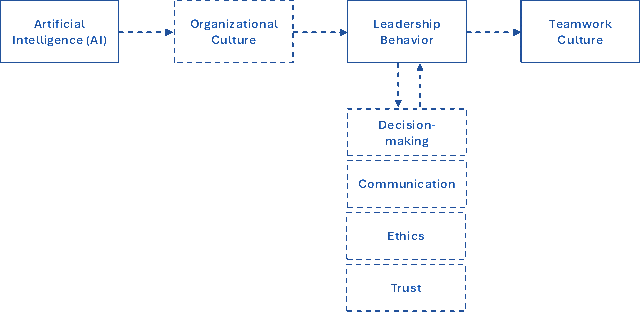 Fig. 1. Conceptual Framework
IV. DATA ANALYSIS
Thematic and descriptive analysis approaches were used to analyze the collected data and draw a purposeful conclusion about the research questions. The questionnaire included demographic and 20 closed-ended questions. The participants’ responses gathered from the questionnaire revealed a comprehensive exploration of the impact of AI in shaping leadership behavior, and the results highlighted five key themes including: 1) perceptions of leadership and AI, 2) trust and ethics in AI, 3) AI factors influencing leadership behavior, 4) AI and teamwork culture, and 5) training, performance, and job satisfaction. The sections outline the process followed to analyze the data and discuss the results supported by relevant data and literature.
The questionnaire results accurately addressed the research questions. 30 employees responded, resulting in a 100% response rate. The demographic questions included gender, age, and experience. Table 1 showed that the majority of participants (63%) were 30 years old and above, and over half (57%) had 10 years or more of experience.
Table 1 Demographic Questions
| Variables | Level | Frequency (n) | Percent (%) |
|---|
| Gender | Female | 17 | 57% |
| Male | 13 | 43% |
| Age | 18 – 24 | 5 | 17% |
| 25 – 29 | 6 | 20% |
| 30 and above | 19 | 63% |
| Experience | 2 | 3 | 10% |
| 4 | 2 | 7% |
| 6 | 8 | 27% |
| 10 and above | 17 | 57% |
A. Perceptions of Leadership and AI
In the first question, 36.7% of participants expressed disbelief in the excellence of leadership behavior in managing teamwork. 33% both agreed and disagreed on the supportiveness of leadership behavior towards AI usage. Furthermore, 30% of participants disagreed on the positive impact of AI on leadership behavior, while 23% agreed. These results suggest potential negative impacts on employees due to leadership behavior, emphasizing the importance for leaders to acquire more skills and knowledge about AI to effectively support its usage, given its increasing significance in organizational operations.
On the other hand, 33% of participants agreed and 16.7% strongly agreed that AI is effective in supporting leadership decision-making, aligning with Wang’s study [11], where leadership can reduce uncertainty and make decisions using AI. Additionally, 13.3% strongly agreed and 30% agreed that AI positively influences work culture, while 30% disagreed. The results from theme 1 indicate varying perceptions regarding the impact of AI, with some perceiving it positively and others negatively, highlighting concerns about leadership understanding and beliefs about AI.
B. Trust & Ethics in AI
In the sixth question, 36.7% disagreed that leadership behavior enhances team members’ trust in AI, while 33.3% agreed. 26.7% agreed that when leadership doesn’t believe in AI, employees’ trust in AI is reduced, while 20% disagreed. These results demonstrate that due to the significant role and influence of leadership, employees are affected by their beliefs; people tend to follow leaders who believe in their beliefs. Moreover, 73.3% strongly agreed and 23.3% agreed that misusing AI and obtaining inaccurate or unreliable results reduces employee trust (Figure 8 – Appendix B), highlighting the importance of ethics. This result aligns with Wang’s [11] study, which emphasized the importance of security and privacy when using AI to avoid negative impacts on employees.
Additionally, 36.7% agreed that when the usage of AI is limited, employee trust in AI will be reduced; supporting Gerlich’s [5] assertion that utilizing AI improves trust and results. However, 56.7% disagreed about promoting ethical guidelines and responsible usage by leadership, underscoring the necessity of ethics in AI usage as stated in Shapiro and Stefkovich’s study [10], and explaining the reason for reduced trust in AI by employees. Furthermore, 43.3% stated that leadership behavior neutrally fosters open communication and team trust regarding the use of AI tools, highlighting the importance of communication skills for efficient teamwork and building relationships with leaders, as noted in Florea and Croitoru’s study [4].
C. AI Factors Influencing Leadership Behavior
The twelfth question showed that 33.3% strongly agreed that data-driven decision-making, communication tools, and performance tracking are factors that influence leadership behavior (Figure 12 – Appendix B). This aligns with Florea and Croitoru’s [4] assertion that AI assists leadership in achieving positive results by tracking employee progress, providing feedback, and coordinating tasks without delays. However, 33.3% disagreed that AI is improving the effectiveness of leadership behavior. Additionally, 20% agreed and 53% found it neutral that automation AI tools influence how leaders delegate and monitor tasks (Figure 14 – Appendix B). This demonstrates that some AI tools help in preventing time-consuming tasks, which can reduce leadership and employee burnout. Herold [6] mentioned that 40% of AI tools can automate tasks and save time.
D. AI & Teamwork Culture
The fifteenth question revealed that 33.3% both agreed and disagreed on the use of AI positively influencing leadership behavior in promoting a stronger teamwork culture. 46.7% agreed and 43.3% disagreed that AI helped leaders create a collaborative and inclusive team environment, which aligns with Păus’s [8] emphasis on the importance of people as they are the main resource in the organization, and AI benefits leadership in inclusivity for all employees as Zidouemba [13] asserted. The disagreement in this result indicates that not all employees are involved in the team environment, leading to a negative experience. However, 16.7% strongly agreed and 26.7% agreed about the strong influence of AI on work culture.
E. Training, Performance & Job Satisfaction
43.3% of participants agreed on their awareness of the importance of leadership training programs related to AI, while 30% disagreed. 36.7% both agreed and disagreed that leadership behavior in using AI improves their performance, demonstrating the impact of leadership behavior on team performance. Good behaviors by leadership such as trust, transparency, and fairness will enhance performance, as mentioned by Saremi et al. [9]. Additionally, 40% agreed and 40% disagreed that leadership behavior influences their overall job satisfaction in an AI-integrated environment, revealing that leadership must be aware of their behavior and the need for training programs related to AI to enhance team performance and ensure job satisfaction for employees.
V. LIMITATION AND RECOMMENDATION
The limitation of this study is the small sample size, which is due to the organization’s small size. This may restrict the generalizability of the results to a broader population. Since the research was conducted in one organization, the findings may not fully represent AI’s role in shaping leadership behavior across other organizations in the UAE. Additionally, the data were collected using only one tool, the questionnaire, which may not provide in-depth insights.
To address these limitations, future research should consider a larger sample size by including multiple organizations to enhance the generalizability and accuracy of the findings. It is also recommended to incorporate additional data collection methods, such as interviews, to gather more in-depth insights, triangulate data, and improve the accuracy, reliability, and validity of the findings.
VI. CONCLUSION
This study utilized a questionnaire for data collection to investigate the influence of AI on shaping leadership behavior to promote an effective teamwork culture. The analysis highlighted the significance of leadership demonstrating fairness in decision-making, effective communication, ethical considerations, and trust utilizing AI. It is necessary for leaders to be aware of their behavior as it highly affects employees, and they should undergo training programs on AI-related topics to build trust in its use and ensure adherence to ethical standards. However, it is essential to acknowledge that the study’s scale is limited and may not be applicable to broader organizations in the UAE.
REFERENCES
[1] Castelvecchi, D. (2016), “Can we open the black box of AI?”, Nature, Vol. 538 No. 7623, pp. 20-23.
[2] Damasio, A.R. (2019), The Strange Order of Things: Life, Feeling, and the Making of Cultures, Vintage, New York, NY.
[3] DESI. (2023). Raportul din 2023 privind stadiul evoluției deceniului digital. Available online: https://digital-strategy.ec.europa.eu/ro/library/2023-report-state-digital-decade
[4] Florea, N. V., & Croitoru, G. (2025). The Impact of Artificial Intelligence on Communication Dynamics and Performance in Organizational Leadership. Administrative Sciences, 15(2), 33. https://doi.org/10.3390/admsci15020033
[5] Gerlich, M. (2024). Exploring motivators for trust in the dichotomy of human-AI trust dynamics. Social Sciences, 13(5), 251.
[6] Herold, B. (2019), “Forty percent of elementary school teachers’ work could be automated by 2030, McKinsey Global Institute Predicts”, Education Week, 4 June.
[7] Paganin, G., De Angelis, M., Pische, E., Violante, F. S., Guglielmi, D., & Pietrantoni, L. (2023). The impact of mental health leadership on teamwork in healthcare organizations: A serial mediation study. Sustainability, 15(9), 7337.
[8] Păus, V. A. (2006). Comunicare și resurse umane. Editura Polirom.
[9] Saremi, M. L., Ziv, I., Asan, O., & Bayrak, A. E. (2025). Trust, workload, and performance in human–artificial intelligence partnering: The role of artificial intelligence attributes in solving classification problems. Journal of Mechanical Design, 147(1), 4065916.
[10] Shapiro, J.P. & Stefkovich, J.A. (2016), Ethical Leadership and Decision-making in Education. Routledge, New York, NY.
[11] Wang, Y. (2021). Artificial intelligence in educational leadership: a symbiotic role of human–artificial intelligence decision-making. Journal of Educational Administration, 59(3), 256–270. https://doi.org/10.1108/JEA-10-2020-0216
[12] Zeng, J., Chen, K., Wang, R., Li, Y., Fan, M., Wu, K., Qi, X., & Wang, L. (2025). ContractMind: Trust-calibration interaction design for AI contract review tools. International Journal of Human-Computer Studies, 196, 103411.
[13] Zidouemba, M. T. (2025). Governance and artificial intelligence: the use of artificial intelligence in democracy and its impacts on the rights to participation. Discover Artificial Intelligence, 5(1), 1–11.
[14] Peifer, Y., Jeske, T., & Hille, S. (2022). Artificial intelligence and its impact on leaders and leadership. Procedia Computer Science, 200, 1024–1030.
[15] Vivek, R., & Krupskyi, O. P. (2024). EI & AI in leadership and how it can affect future leaders.
[16] Frimpong, V. (2025). The Impact of AI on Evolving Leadership Theories and Practices. Journal of Management, 3, 188–193.
[17] Dwivedi, D. (2025). Emotional Intelligence and Artificial Intelligence Integration Strategies for Leadership Excellence. Advances in Research, 26(1), 84–94.