I. INTRODUCTION
Governments throughout the world now work to enhance operational performance as public expectations about service quality continue to increase. Weber described bureaucracy as a rational-legal system designed for administration, but people now attribute its inefficiencies to this method. The documented inefficiencies embrace procedural complexities together with administrative burdens and delays, whereas these elements eat up 20–30% of administrative capacities but demonstrate no corresponding added value. Administration burden in European Commission estimates requires EU businesses to spend around €124 billion every year while total economies suffer costs reaching billions annually.
Government leaders have adopted digital transformation agendas throughout the past two decades by attempting to digitize existing bureaucratic processes at first. Governing institutions commonly shifted toward “digitized bureaucracy” instead of true transformation through their digitalization projects. Presently, governments apply Artificial Intelligence (AI) technology as part of their efforts to establish new fundamental approaches for administrative procedures. AI represents a strategic tool for efficient processing which helps decision makers achieve better accuracy as well as deliver superior services. The governments of Estonia together with Singapore and the United Kingdom use AI technology for different administrative processes.
The government adoption of AI systems leads to multiple issues about future bureaucratic choices and public accountability while changing how citizens relate to state institutions. The implementation of AI tools requires careful planning because concerns over algorithmic prejudice together with transparency issues and the threat of promoting social gaps need democratic structures which ensure effective governance principles and fairness. The problem goes beyond technological implementation because it requires redesigning existing bureaucratic systems to adapt them to digital functionality.
The motivation for this research stems from a significant gap in current literature on the application of artificial intelligence to reduce bureaucratic processes. Research on AI adoption procedures by government and digital governance theories remains substantial, yet empirical studies on AI-enabled streamlining of bureaucratic non-value-adding processes remain scarce. Investigative studies have mostly explored individual model deployments and theoretical analysis while missing the relationship between automation implementation and bureaucracy performance across various governmental functions. Specifically, the research question is whether the implementation of AI will lead to zero bureaucracy while increasing efficiency.
The rest of the paper is structured as follows: Section II examines the related literature. Section III presents the theoretical frameworks and hypotheses. Section IV outlines the methodology, Section V provides preliminary findings, and Section VI concludes.
II. LITERATURE REVIEW
III. HYPOTHESES AND CONCEPTUAL MODEL
This paper adopts the substitution–augmentation classification of automation technologies when developing its theoretical model, linking task features (complexity and uncertainty) to AI-driven changes and classifying forms of discretion. A complementary framework separates administrative transformation affecting procedures directly from broader organizational changes affecting credibility and service delivery quality. Combining these perspectives yields a comprehensive AI impact model that identifies both process changes and protections for core governance systems.
Hypotheses
H1: The integration of AI tools in government processes is positively associated with efficiency.
H2: The integration of AI tools in government processes will be negatively associated with bureaucratic delays.
H3: The integration of AI tools in government processes will be positively associated with public satisfaction with governance services.
Conceptual Model
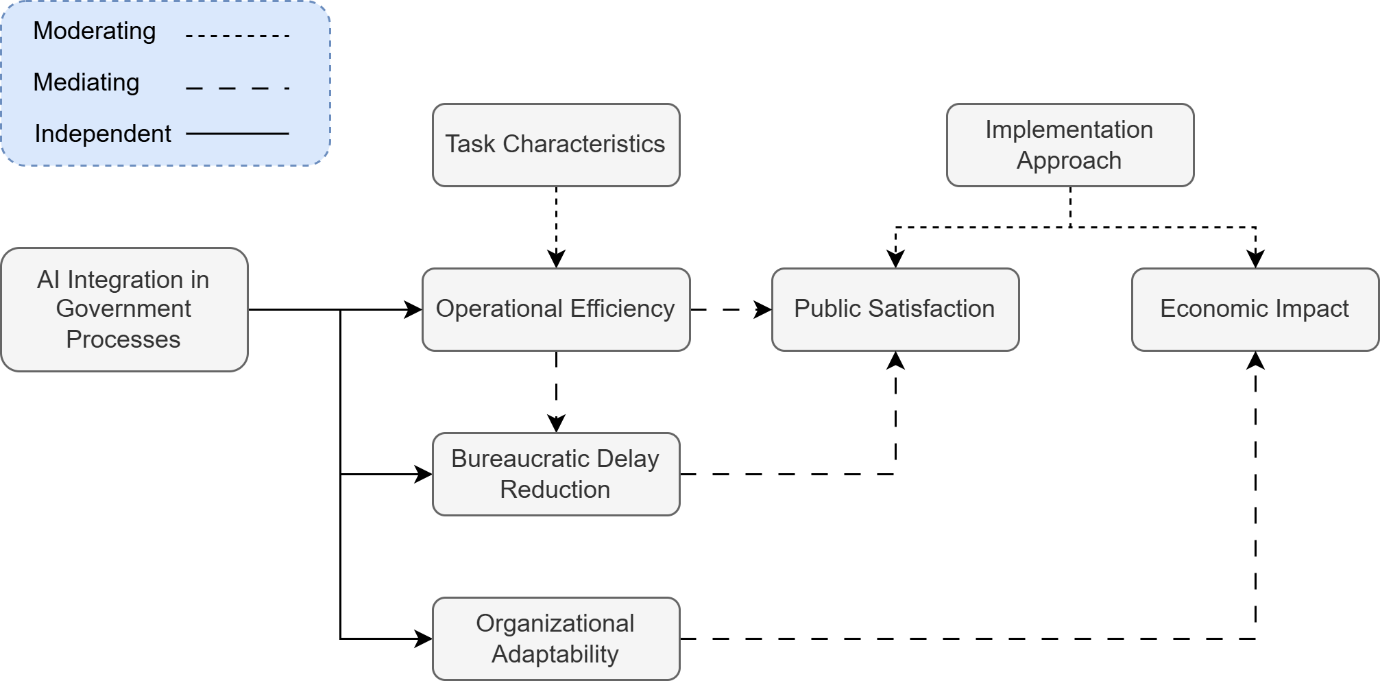
The theoretical model conceptualizes the relationships between AI adoption and bureaucratic performance. AI adoption (technology type, scope, and sophistication) influences operational efficiency, bureaucratic delay reduction, and public satisfaction, directly and via mediators such as task characteristics, organizational flexibility, and implementation approach (augmentation vs. automation). Control variables include demographics, prior technology exposure, and trust in government.
Figure 1. Conceptual Model.
IV. METHODOLOGY
V. FINDINGS
A total of 224 respondents from diverse demographics completed the survey. The majority were aged 25–34 (46.9%), followed by 35–44 (25%), and under 25 (17.9%). The gender balance was relatively even (51.3% female, 48.7% male).
Initial findings indicate varying confidence across AI perception measures, with satisfaction with current services scoring highest and perceptions of AI’s corruption-reduction potential lowest—suggesting respondents have more confidence in operational improvements than governance impacts. AI awareness was high: 37.5% “very familiar” and 46.9% “somewhat familiar” with AI in government services; only 2.7% had not heard about it. Regarding efficiency, 87.5% agreed AI could improve government service efficiency (46% strongly agree; 41.5% agree).
65.6% of respondents saw bureaucratic delays as a major issue, while 39.7% expressed satisfaction with current service speed. This gap suggests the need to address inefficiencies. When asked about AI’s effectiveness in tackling these inefficiencies, 85.8% rated AI as “very effective” (42.9%) or “effective” (42.9%).
VI. IMPLICATIONS AND CONCLUSION
This research contributes to theory on bureaucratic change in the age of AI. Preliminary findings indicate a robust connection between AI integration and efficiency expectations, illustrating how technology upgrading can strengthen—rather than weaken—service delivery.
Practically, results underscore the need for digital literacy programs for citizens and government officials to enable a smoother transition to AI-facilitated governance.
REFERENCES
[1] Weber, M., 2019. Economy and society: A new translation. Harvard University Press.
[2] Newman, J., Mintrom, M. and O’Neill, D., 2022. Digital technologies, artificial intelligence, and bureaucratic transformation. Futures, 136, p.102886.
[3] European Commission, 2018. Better regulation: Taking stock and sustaining our commitment. European Commission, Brussels. [online] Available at: https://commission.europa.eu/law/law-making-process/better-regulation/better-regulation-taking-stock-and-sustaining-our-commitment_en [Accessed date: 1 March 2025]
[4] Dunleavy, P., Margetts, H., Bastow, S. and Tinkler, J., 2006. New public management is dead—long live digital-era governance. Journal of Public Administration Research and Theory, 16(3), pp.467–494.
[5] Straub, V.J., Morgan, D., Bright, J. and Margetts, H., 2023. Artificial intelligence in government: Concepts, standards, and a unified framework. Government Information Quarterly, 40(4), p.101881.
[6] Wirtz, B.W., Weyerer, J.C. and Geyer, C., 2019. Artificial intelligence and the public sector—applications and challenges. International Journal of Public Administration, 42(7), pp.596–615.
[7] Margetts, H., 2022. Rethinking AI for good governance. Daedalus, 151(2), pp.360–371.
[8] Young, M.M., Himmelreich, J., Bullock, J.B. and Kim, K.C., 2019. Artificial intelligence and administrative evil. Perspectives on Public Management and Governance, 4(3), pp.244–258.
[9] Lipsky, M., 2010. Street-level bureaucracy: Dilemmas of the individual in public service. Russell Sage Foundation.
[10] Bovens, M. and Zouridis, S., 2002. From street-level to system-level bureaucracies: how information and communication technology is transforming administrative discretion and constitutional control. Public Administration Review, 62(2), pp.174–184.
[11] Bullock, J.B., 2019. Artificial intelligence, discretion, and bureaucracy. The American Review of Public Administration, 49(7), pp.751–761.
[12] Pencheva, I., Esteve, M. and Mikhaylov, S.J., 2020. Big Data and AI—A transformational shift for government: So, what next for research? Public Policy and Administration, 35(1), pp.24–44.
[13] Cordella, A. and Tempini, N., 2015. E-government and organizational change: Reappraising the role of ICT and bureaucracy in public service delivery. Government Information Quarterly, 32(3), pp.279–286.
[14] Straub, V.J., Hashem, Y., Bright, J., Bhagwanani, S., Morgan, D., Francis, J., Esnaashari, S. and Margetts, H., 2024. AI for bureaucratic productivity: Measuring the potential of AI to help automate 143 million UK government transactions. arXiv:2403.14712.
[15] Hong, S.H., 2023. Prediction as extraction of discretion. Big Data & Society, 10(1), p.20539517231171053.
[16] Gritsenko, D. and Wood, M., 2022. Algorithmic governance: A modes of governance approach. Regulation & Governance, 16(1), pp.45–62.
[17] Acemoglu, D. and Restrepo, P., 2020. The wrong kind of AI? Artificial intelligence and the future of labour demand. Cambridge Journal of Regions, Economy and Society, 13(1), pp.25–35.
[18] European Union Agency for Fundamental Rights, 2020. Getting the future right: Artificial intelligence and fundamental rights. Publications Office of the European Union. [online] Available at: https://fra.europa.eu/en/publication/2020/artificial-intelligence-and-fundamental-rights [Accessed date: 2 March 2025]
[19] Herd, P. and Moynihan, D.P., 2019. Administrative burden: Policymaking by other means. Russell Sage Foundation.