Article
The Integration Of Generative AI Into Computer Programming Education: Students Perspective
Khuloud Alhamedi - College of Technological Innovation - Zayed University - Abu Dhabi, UAE -
M80008946@zu.ac.ae -
Ashraf Khalil - College of Technological Innovation - Zayed University - Abu Dhabi, UAE -
Ashraf.Khalil@zu.ac.ae -
Mohammad Kuhail - College of Technological Innovation - Zayed University - Abu Dhabi, UAE -
Mohammad.Kuhail@zu.ac.ae -
Rafiq Hijazi - College of Natural and Health Sciences - Zayed University - Abu Dhabi, UAE -
Rafiq.Hijazi@zu.ac.ae
Due to the growing number of open-source generative AI models and the development of models with advanced capabilities, generative AI has become more accessible and is being utilized in various fields, including education. This research aims to identify the factors influencing higher education students’ intention to use generative AI tools in computer programming courses by extending the Technology Acceptance Model (TAM) with a quantitative approach. The data was collected by distributing a survey among students from different universities, and 205 responses were received. The findings indicate that key constructs such as perceived usefulness, trust in the tool, perceived ethics, and attitude toward AI significantly influence the students’ usage intention.
Keywords: Generative AI, AI in Education, TAM, Computer Programming, Higher Education, Students' Generative AI Usage Intention
I. INTRODUCTION
Recently, many major tech companies, such as Google, OpenAI, and X, have been competing to develop the best generative AI model. According to [1] 65.7% of the newly released models in 2023 were open source compared to 44.4% in 2022. This indicates an increase of 21.3% within a period of one year, with an increase in Generative AI investment by almost 800% in 2023, reaching $25.2 billion. As a result, generative AI tools have become more accessible and are providing enhanced capabilities to various users, including students.
Moreover, this growing accessibility has led to a disruption in the traditional process of teaching programming courses. Educators and researchers believe that the use of generative AI in programming courses can transform such courses, which are usually known for their high student-to-teacher ratios, time-consuming grading processes, and lack of personalized feedback [2], [3]. Therefore, recent studies have begun exploring different strategies for integrating generative AI tools in programming education, focusing on the associated benefits and challenges these technologies will bring to the learning environment.
Although recent studies are exploring the capabilities of generative AI tools and how they can be used to enhance programming education, there is still limited research covering the Gulf region in general and the United Arab Emirates (UAE) specifically. According to [4], the existing research on AI in higher education in the GCC is still developing, and studies that focus on the use of generative AI in programming education are limited.
These regional gaps are significant in the UAE, where the integration of AI education is one of the main parts of the UAE Artificial Intelligence Strategy 2031, which aims to position the country as one of the global leaders in AI development and integration [5]. As part of this vision, the UAE has invested in AI infrastructure, innovation, and education, with a strong focus on ensuring that the graduates are future-ready. This can be seen in the country’s high STEM engagement, where 36.2% of higher education graduates specialize in areas related to science, technology, engineering, and mathematics [6].
The study seeks to answer the following questions:
RQ1. What are the key factors influencing students’ intention to adopt generative AI tools in programming education within UAE higher education institutions?
RQ1.1. How does students’ perceived usefulness and ease of use of generative AI tools in programming tasks impact intention to use them?
RQ1.2. How do trust and perceived ethics affect the students’ intention to use generative AI tools?
RQ1.3. How do social influence and students' attitudes toward AI affect their acceptance of these tools in programming education?
RQ2. What are the associated benefits and challenges of integrating generative AI tools in educational settings?
RQ3. What ethical considerations should educational institutions take into consideration when integrating generative AI in UAE programming education?
This study aims to address these gaps by focusing on exploring the factors which influence the students’ intention to use generative AI tools such as ChatGPT, GitHub Copilot, and Gemini in computer programming courses by extending the Technology Acceptance Model (TAM). The extended model includes additional constructs such as trust in the tool, perceived ethics, social influence, and attitude toward AI. By focusing on higher education students in the UAE, this study aims to provide insights that will support more effective and ethical integration of generative AI tools in programming education.
II. METHODOLOGY
A. Research Design and Approach
This study explores the factors influencing students’ intention to use Generative AI tools in computer programming courses by extending the Technology Acceptance Model (TAM), following an explanatory research design. Based on the survey responses, the direct and indirect relationships between the model constructs will be examined using Structural Equation Modeling (SEM-PLS), while SPSS will be used to conduct the descriptive analysis. SEM-PLS was selected due to its suitability for exploratory studies and how it allows the testing of complex models with latent variables.
Furthermore, the study adopts a deductive approach, beginning with an established theoretical framework (TAM) and extending it by testing predefined hypotheses drawn from existing literature and empirical observations. This approach allows the evaluation of the validity and reliability of the proposed extended TAM model.
B. Ethical Consideration
To ensure the ethical integrity of this study, an ethical clearance was obtained from Zayed University’s Research Ethics Committee. Adhering to this procedure ensures that data confidentiality and participant anonymity are maintained. Additionally, it guarantees that participants read and agree to the provided consent form before participating in the survey, that all collected data are securely stored and accessed only by the research team, and that the participants are fully aware of their right to withdraw at any time. These measures align with the research ethics guidelines, ensuring that the thesis upholds transparency, confidentiality, and voluntary participation as participants are fully informed of their right to withdraw at any time.
C. Data Sources and Participants
This study employs a quantitative research methodology, as it examines the factors influencing higher education students’ intention to use Generative AI in computer programming courses. A structured survey was created using Google Forms and used as the primary data collection method to maximize the survey's accessibility and convenience. The target participants for this study are higher education students enrolled in computer programming courses in the UAE. A non-probability sampling technique, specifically purposive sampling, was used to ensure that only students with relevant academic backgrounds participated. The survey was distributed through the university email, and student WhatsApp and Telegram groups. The data was collected over a period of four weeks from the end of February 2025 to the end of March 2025. The survey started by providing the participants with a brief overview of the study purpose and a consent form before accessing the survey and participants were informed that their responses would remain anonymous and confidential.
D. Instrument and Pilot Testing
The survey was divided into three main sections: Demographic information, AI Tool usage, and the main part. Before starting the actual data collection process, a pilot test was conducted. The survey link was shared only with family members and friends who met the criteria of the target participants. In total, ten students participated in the pilot testing. The aim of this test was to ensure the clarity, consistency, and reliability of the developed research instrument by collecting feedback from participants and reflecting it in the final version of the survey. Additionally, pilot testing helped identify any technical issues and ensured that the responses are received and stored securely.
III. RESULTS
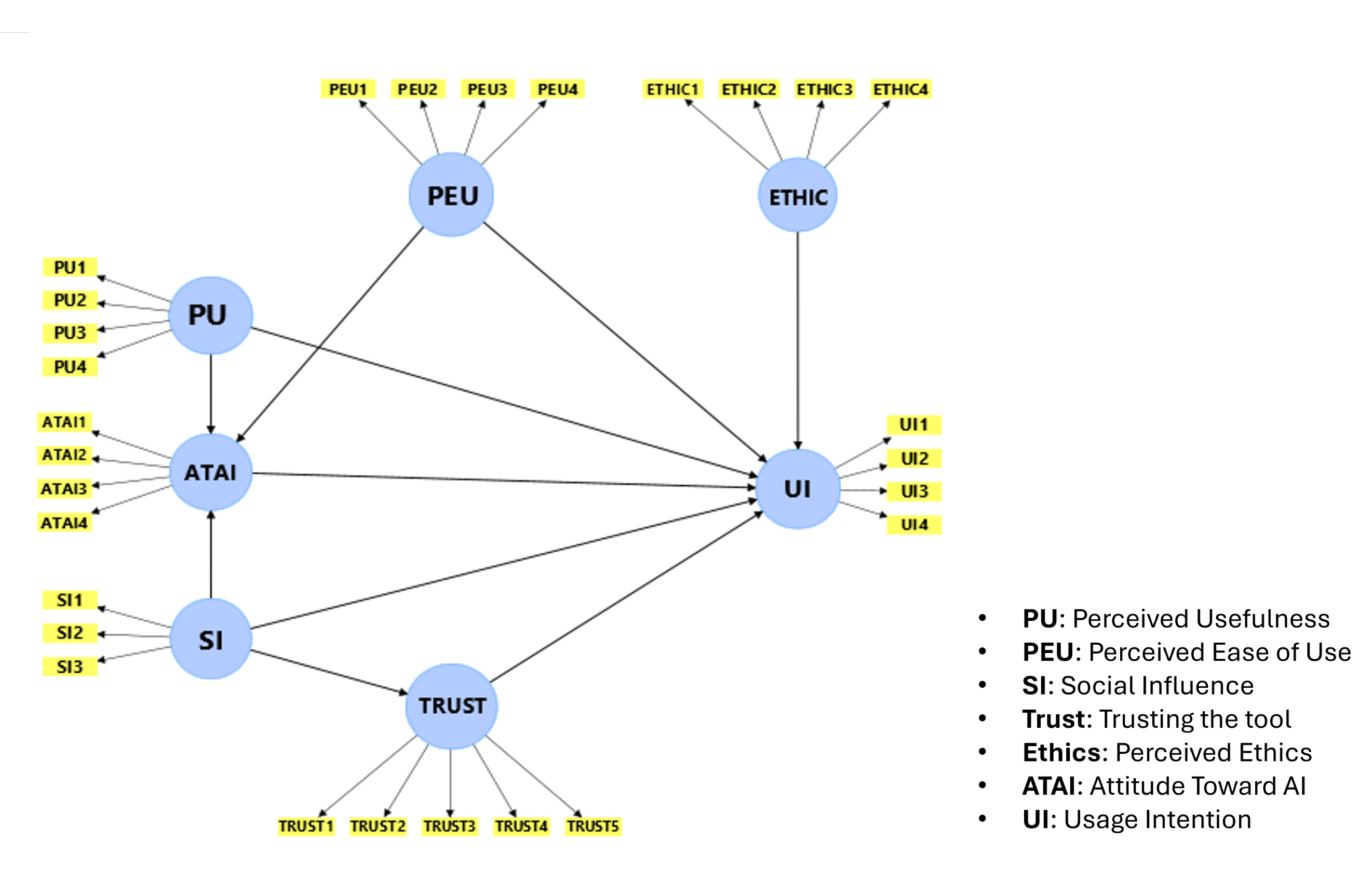
In order to understand the factors influencing the student’s usage intention of generative AI tools, the TAM model was extended. The final model contained seven constructs: perceived usefulness (PU), perceived ease of use (PEU), social influence (SI), trust in AI tools (TRUST), perceived ethics (ETHIC), attitude towards AI (ATAI), and usage intention (UI). Ten hypotheses were tested, covering the impact of these variables on students’ intention to use GAI tools, their attitude toward AI, and the influence of social influence on trust.
A survey was developed based on the literature, with multiple items measuring each construct. The survey was distributed among higher education students in the UAE, and a total of 205 responses were received. After data cleaning, five responses were removed due to the lack of consent, incorrect university information, or being from a university outside the UAE.
SPSS was used to perform descriptive analysis, providing an overview of the sample characteristics, while SmartPLS was used to test the hypotheses using both PLS-SEM and bootstrapping algorithms.
After completing the data analysis, seven out of ten hypotheses were supported. Hypotheses related to the correlation between perceived usefulness, trust in the tool, perceived ethics, and attitude toward AI and the student's usage intention were supported. In contrast, an insignificant correlation was found between social influence and perceived ease of use with usage intention. Additionally, social influence was found to have an indirect impact by shaping students’ attitudes and trust toward AI.
These results indicate that higher education students prioritize the tool’s value, reliability, accuracy, and ethical alignment over its ease of use. This was an unexpected result, as most literature reported a significant correlation between PEU and the intention to use generative AI tools.
 A. Theoretical Implications
This study contributes to the theoretical advancement of the Technology Acceptance Model (TAM) by extending its constructs to include constructs related to the education context focusing mainly on the integration of generative AI in computer programming education. Based on the analysis result, constructs such as trust, ethics, social influence, and attitude towards AI are significant extensions to the original model.
The findings from hypotheses eight and nine concluded a significant influence between ethics and trust on the student’s intention to use generative AI, emphasizing the importance of including constructs related to values such as trust in models involving AI. This is because artificial intelligence tools introduce dimensions such as model bias, accuracy, and transparency.
Moreover, the strong correlation between attitude toward AI and usage intentions shows the importance of ATAI as a mediating variable in the TAM model. Surprisingly, perceived ease of use (PEU) had an insignificant influence on the students’ usage intention, which is the opposite of the expected results reported in the literature. This suggests that digitally mature users value trust, ethics, and usefulness more than ease of use.
B. Practical Implications
The results of this study provide insights that can support generative AI developers, curriculum developers, and instructors. Generative AI tool developers can benefit from knowing the key variables influencing the student’s usage intention. For example, since the results show that students value trust and usefulness, developers should enhance the transparency, reliability, and explainability of the tools they build.
Curriculum developers will benefit from knowing how students used those tools in computer programming and who depend on those tools more, whether it is students in earlier academic years or later. This will help in understanding the best time to integrate the tools in programming education and in which tasks it can be integrated without affecting the students' learning outcomes negatively. Instructors will also get useful insights on how students are utilizing generative AI tools.
IV. CONCLUSION
In conclusion, this study aims to explore the factors influencing the intention to use generative AI in higher education, focusing on the students’ perspective. Three main research questions were the focus of this study, where some questions focus on understanding the current challenges, benefits, and the ethical concerns of integrating such tools in higher education by reviewing current literature. While other research questions focus on understanding the main factors that affect the usage intention of generative AI tools in computer programming courses among higher education students in the UAE.
To understand the factors influencing the student’s usage intention, the TAM model was extended and the final model contained seven constructs, including perceived usefulness, perceived ease of use, social influence, trusting AI tools, perceived ethics, attitude towards AI, and usage intention. Ten hypotheses were tested, and the results showed that perceived usefulness, trust in the tool, perceived ethics, and attitude toward AI had a significant impact on the students’ usage intention. In contrast, an insignificant correlation was found between social influence and perceived ease of use with usage intention. Additionally, social influence had an indirect impact by shaping students’ attitudes and trust toward AI. This indicates that higher education students prioritize the tool’s value, reliability, accuracy, and ethical alignment over its ease of use (refer to Table 1 and Table 2).
Future studies should include participants from different academic majors, which will allow the researchers to assess whether students in different fields have varying levels of acceptance, trust, and ethical concern regarding the integration of generative AI.
Moreover, adding extra methods to collect the data, such as experiments and interviews, will help in providing additional insights. Conducting controlled experiments in different universities across the UAE could help in determining whether different teaching methods or institutional cultures influence the students' usage intention.
Since the majority of the participants in the survey were students in later academic years (third year or more), it is important to also investigate the ideal stage within a student’s academic journey at which AI tools should be introduced. This will help in understanding whether early integration of generative AI tools in foundational programming courses results to better outcomes, or if generative AI tools are best suited for use in more advanced, project-based learning environments.
Finally, future research should also explore the instructors’ perspectives, as their role is critical in shaping the classroom norms and influencing the students’ trust in generative AI technologies. Also, understanding the instructors’ attitudes toward generative AI tools, their challenges in implementing such tools, and their ethical concerns can provide a more holistic view of the topic.
Tables
Table 1. PATH COEFFICIENTS
| Path |
T-statistics |
P-values |
| ATAI → UI | 8.8 | 0 |
| ETHIC → UI | 1.998 | 0.046 |
| PEU → ATAI | 1.69 | 0.091 |
| PEU → UI | 0.334 | 0.738 |
| PU → ATAI | 5.312 | 0 |
| PU → UI | 1.962 | 0.05 |
| SI → ATAI | 3.404 | 0.001 |
| SI → TRUST | 12.827 | 0 |
| SI → UI | 0.131 | 0.896 |
| TRUST → UI | 2.988 | 0.003 |
Table 2. HYPOTHESES DECISION
| Hypothesis |
Path |
Decision |
| H1. Perceived Usefulness positively influences the students’ intention to use generative AI tools in computer programming education. | PU → UI | Supported |
| H2. Perceived Usefulness positively influences the students’ Attitude towards AI. | PU → ATAI | Supported |
| H3. Perceived Ease of Use positively influences the students’ intention to use generative AI tools in programming education. | PEU → UI | Rejected |
| H4. Perceived Ease of Use has a significant influence on the students’ Attitude towards AI. | PEU → ATAI | Rejected |
| H5. Social Influence significantly influences the students’ intention to use generative AI tools in programming education. | SI → UI | Rejected |
| H6. Social Influence positively influences the students’ attitude towards AI in programming education. | SI → ATAI | Supported |
| H7. Social Influence positively influences the students’ trust in AI in programming education. | SI → TRUST | Supported |
| H8. Trust positively influences the students’ intention to use generative AI tools in programming education. | TRUST → UI | Supported |
| H9. Perceived ethics positively influence the students’ intention to use generative AI tools in programming education. | ETHIC → UI | Supported |
| H10. A positive Attitude Toward AI positively influences the students’ intention to use generative AI tools in programming education. | ATAI → UI | Supported |
REFERENCES
[1] N. Maslej, L. Fattorini, R. Perrault, V. Parli, R. Reuel, and E. Brynjolfsson, “The AI Index 2024 Annual Report,” Stanford HAI, Stanford University, 2024. [Online]. Available: https://aiindex.stanford.edu
[2] M. Abolnejadian, S. Alipour, and K. Taeb, “Leveraging ChatGPT for Adaptive Learning through Personalized Prompt-based Instruction: A CS1 Education Case Study,” in Extended Abstracts of the CHI Conference on Human Factors in Computing Systems, Honolulu HI USA: ACM, May 2024, pp. 1–8. doi: 10.1145/3613905.3637148.
[3] M. Kazemitabaar et al., “CodeAid: Evaluating a Classroom Deployment of an LLM-based Programming Assistant that Balances Student and Educator Needs,” in Proceedings of the CHI Conference on Human Factors in Computing Systems, Honolulu HI USA: ACM, May 2024, pp. 1–20. doi: 10.1145/3613904.3642773.
[4] F. K. Fadlelmula and S. M. Qadhi, “A systematic review of research on artificial intelligence in higher education: Practice, gaps, and future directions in the GCC,” J. Univ. Teach. Learn. Pract., vol. 21, no. 06, Apr. 2024, doi: 10.53761/pswgbw82.
[5] United Arab Emirates Minister of State For Artificial Intelligence Office, “UAE National Artificial Intelligence Strategy 2031,” 2018. [Online]. Available: https://ai.gov.ae/wp-content/uploads/2021/07/UAE-National-Strategy-for-Artificial-Intelligence-2031.pdf
[6] K. Buchholz, “Where Students Choose STEM Degrees,” Statista Daily Data. Accessed: Apr. 06, 2025. [Online]. Available: https://www.statista.com/chart/22927/share-and-total-number-of-stem-graduates-by-country