This paper examines how generative artificial intelligence can support the development of sustainable and energy-efficient public transportation in the United Arab Emirates. It analyzes current applications in Dubai and Abu Dhabi, identifies barriers to wider adoption, and explores opportunities for optimizing routes and energy use. A qualitative research method was used, involving expert interviews and thematic analysis supported by a Large Language Model. Findings reveal Dubai’s advanced adoption compared to Abu Dhabi’s pilot initiatives. Key barriers include regulatory gaps, infrastructure and data limitations, and cultural resistance. A five-phase framework is proposed to guide systematic AI deployment toward net-zero goals.
Keywords: generative artificial intelligence, public transportation, net-zero, sustainable mobility, route optimization, AI framework
I. BACKGROUND
Public transportation is an important part of the urban mobility system in the UAE. It relies heavily on systems to meet the growing demands of urbanization with networks of buses, metro, and trams serving millions of passengers, cities like Dubai and Abu Dhabi [1]. For example, the Dubai Metro is one of the world’s largest driverless metro systems, supported by an extensive bus and tram network [2]. However, despite these achievements, the UAE’s public transportation sector still faces challenges in achieving long-term sustainability, especially regarding reducing emissions while meeting increasing demand [3].
The UAE has made significant commitments to sustainability through national strategies such as the UAE Energy Strategy 2050 and the Net Zero by 2050 Strategic Initiative [1]. These strategies aim to lower carbon emissions and increase the role of renewable energy, particularly in sectors such as transportation. Although progress has been made, the transport sector still accounts for a significant share of the country's greenhouse gas emissions. This highlights the urgent need for new and innovative solutions to make public transportation more efficient and environmentally friendly.
Generative artificial intelligence (AI) is one such promising solution. It is a fast-growing technology known for its ability to create, predict, and optimize complex systems. In public transportation, generative AI can improve route planning, reduce energy use, and support predictive maintenance. These features can contribute to building a more sustainable transport system that helps the UAE reach its environmental goals.
Despite improvements in AI technologies globally, challenges remain in integrating generative AI into the UAE’s public transportation system. High energy consumption, dependence on fossil fuels, traffic congestion, and inefficient routes continue to impact sustainability. Transportation growth adds further pressure, making it even more difficult to create an efficient and eco-friendly transport system.
This paper proposes a detailed framework for applying generative AI in the UAE’s public transportation sector to respond to this gap. The aim is to show how AI can improve system performance, reduce emissions, and contribute to national climate goals. The study focuses on three main areas where AI can make a difference: real-time optimization of transport routes, predictive traffic modeling, and energy consumption reduction. The framework introduced in this paper offers a structured, five-phase approach that aligns with national strategies such as the UAE’s Net Zero 2050 goals.
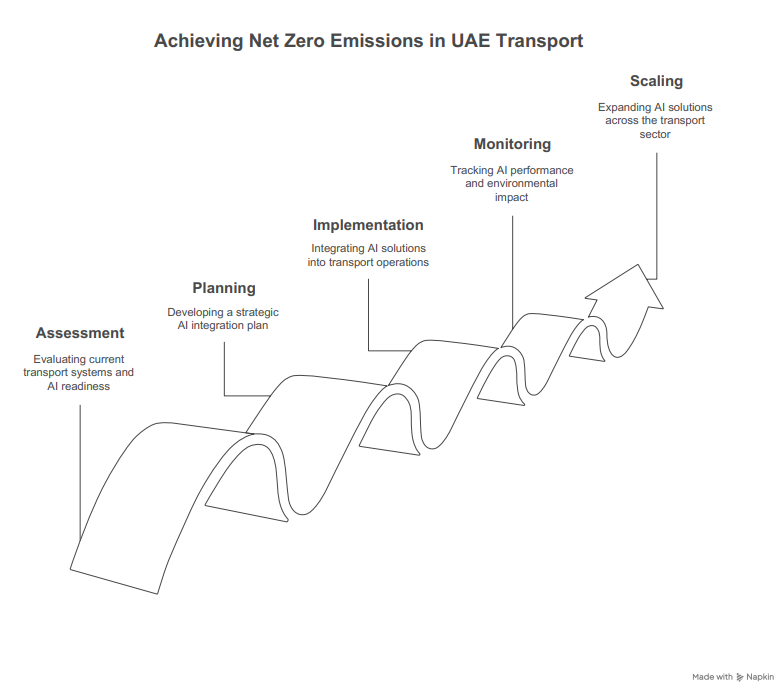
The proposed framework includes five phases: Assessment, Planning, Implementation, Monitoring, and Scaling. These phases provide a step-by-step guide for decision-makers and transport authorities, showing how generative AI can be gradually and effectively introduced. Each phase focuses on specific goals—identifying baseline emissions and system readiness to scaling successful AI projects across emirates. This structure supports a smooth and measurable transition toward smarter, cleaner, and more efficient transportation.
This study aims to contribute practical recommendations for the future use of generative AI in UAE transportation systems. It aligns closely with national sustainability goals and supports the country’s broader efforts to lead in innovation and climate action. The study focuses on land-based transportation, such as buses, trams, and metro systems. Other modes of transport, such as aviation or maritime, are beyond the scope of this paper.
The research addresses three core questions:
- How is generative AI currently utilized in Dubai and Abu Dhabi public transportation?
- What are the major barriers to deploying generative AI across the UAE’s transport systems?
- How can generative AI support real-time route optimization and energy management toward achieving net-zero goals?
II. METHODOLOGY
This study adopts a qualitative research approach to develop a structured framework for deploying generative artificial intelligence within the UAE’s public transportation system. A qualitative method was chosen because it focuses on exploring expert opinions and understanding the practical, technical, and strategic challenges involved in integrating AI technologies to achieve sustainability goals.
The research follows an interpretive paradigm, seeking to extract recurring themes, patterns, and expert perspectives to build meaningful insights. To enhance the analysis, thematic analysis was explicitly used as the main qualitative method. Claude 3, a generative AI model, supported the thematic analysis by helping organize the interview data, categorize responses, and identify emerging themes efficiently.
Primary data were collected through semi-structured interviews with five experts selected through purposive sampling. These experts represented diverse fields including transportation policy, AI development, environmental sustainability, and public sector strategy. Interviews were conducted either virtually or in person, recorded with consent, and transcribed for detailed analysis. Interview questions focused on exploring current applications of AI, identifying barriers to AI adoption, and understanding how AI could contribute to the UAE’s Net Zero 2050 goals.
Secondary data were also reviewed, including government transportation reports, national sustainability plans, and academic literature. This ensured that the findings were supported by broader data sources and grounded in relevant policy contexts.
1) Data Analysis Process
- Transcription and anonymization of all expert interviews.
- Uploading transcripts to Claude 3’s platform for AI-assisted coding.
- Prompting Claude 3 with targeted queries to extract themes related to AI applications, barriers, regional differences (Dubai vs. Abu Dhabi), and sentiment toward AI adoption.
- Manual review of Claude 3 outputs to ensure thematic accuracy and contextual understanding.
- Cross-validation using Napkin AI-generated visual summaries to confirm the consistency and depth of themes.
- Inter-coder reliability testing by reanalyzing 20% of the transcripts manually, achieving over 90% agreement.
The findings from this thematic analysis directly informed the development of the five-phase framework proposed in the study.
2) Framework Development and Propositions
- Assessment: Evaluating AI readiness, stakeholder roles, and infrastructure gaps.
- Planning: Defining AI use cases, setting strategic goals, and developing governance models.
- Implementation: Piloting AI solutions, upgrading digital infrastructure, and training operational staff.
- Monitoring: Tracking performance through KPIs, such as emissions reductions and service efficiency.
- Scaling: Expanding successful AI initiatives across emirates and integrating emerging technologies.
Rather than hypotheses, the study presents three propositions:
- Proposition 1: Dubai demonstrates greater readiness and operational integration of generative AI compared to Abu Dhabi.
- Proposition 2: Barriers such as policy fragmentation, technical limitations, and cultural resistance limit AI deployment in the UAE.
- Proposition 3: Generative AI can support at least a 20% reduction in transportation-related greenhouse gas emissions through optimized routing, energy management, and predictive maintenance.
3) Validation Strategy
- Standardized interview protocols were applied across all interviews.
- Data triangulation was conducted by combining primary interviews, secondary sources, and literature reviews.
- Expert feedback was sought after the initial analysis to validate interpretations.
- Inter-coder reliability was checked to maintain thematic consistency.
4) Future Empirical Validation
- Pilot case studies testing the five-phase framework in selected transport systems (e.g., Dubai’s RTA).
- Follow-up expert interviews to refine the framework based on real-world deployment experiences.
- Quantitative measurement of emissions reductions, operational improvements, and user acceptance in AI-enabled transport networks.
This future empirical validation would strengthen the generalizability and practical relevance of the proposed framework.
III. RESULTS AND FRAMEWORK PROPOSAL
A. Current Use of Generative AI in Dubai and Abu Dhabi
Dubai has shown clear progress in integrating AI within its public transportation system. The Roads and Transport Authority (RTA) has adopted technologies such as real-time route optimization, smart traffic control, on-demand mobility services, and predictive maintenance. One expert shared that generative AI is being used to re-route buses during congestion, which improves travel time and reduces emissions. Another mentioned how the RTA uses AI simulations for long-term transport planning, contributing to its broader smart city strategy.
The digital infrastructure of Dubai enables AI solutions like congestion mapping, demand forecasting, and electric vehicle charging optimization to operate effectively. Experts emphasized that Dubai’s success is linked to strong institutional support and strategic planning. In contrast, Abu Dhabi is still developing its approach. While it has launched pilot projects such as electric bus tracking and AI-supported traffic control, implementation is limited. Experts noted gaps in infrastructure, policy coordination, and cross-sector collaboration. Abu Dhabi’s use of AI remains experimental, highlighting the need for a centralized roadmap and increased investment.
B. Barriers to Generative AI Deployment
Analysis revealed four primary barriers:
- Policy gaps: There is no unified regulatory framework for AI in transport. Differences across emirates and lack of clarity around ethics, data sharing, and legal responsibility limit progress.
- Infrastructure readiness: Experts noted uneven access to digital tools and systems. Outside of Dubai, many areas lack sensors, smart platforms, and EV charging infrastructure, making full AI deployment difficult.
- Skills and data: Most transport agencies face limited access to high-quality, real-time data and a shortage of trained personnel to operate AI systems.
- Cultural resistance: Public users and staff may distrust automated systems without clear communication or training. This slows adoption and limits the perceived value of AI.
C. Transformative Potential and Framework Relevance
Despite challenges, experts agreed that generative AI can significantly improve operational efficiency, reduce emissions, and support data-driven transportation planning. Benefits include real-time route planning, predictive maintenance, and energy management. AI can forecast demand, align services with renewable energy, and optimize electric fleet performance. When fully adopted, AI could reduce emissions by at least 20%, based on expert estimates.
A five-phase framework was proposed: Assessment, Planning, Implementation, Monitoring, and Scaling to support a structured rollout aligned with UAE sustainability goals and ensure flexibility for long-term innovation.
D. Proposed Framework for AI Deployment
The paper proposes a structured five-phase deployment framework to address the identified challenges and enable the scalable adoption of generative artificial intelligence in public transportation. The first phase,
Assessment, involves evaluating the current state of the transportation system, including its carbon footprint, the readiness of digital infrastructure, the quality and availability of relevant data, and the institutional capacity to support AI integration to ensure that any AI strategy is built on a clear understanding of existing conditions. The second phase,
Planning, focuses on defining specific AI use cases such as route optimization, predictive maintenance, and energy forecasting and aligning them with the UAE’s national climate goals. It also includes the development of data governance policies, ethical guidelines, and performance targets. In the
Implementation phase, generative AI tools are tested through pilot projects in high-impact areas. The fourth phase,
Monitoring, ensures that the performance of AI systems is evaluated using real-time key performance indicators such as emissions reductions, fuel efficiency, and user satisfaction that allow for continuous improvement and data-driven adjustments. Finally, the
Scaling phase focuses on expanding successful pilot initiatives across additional emirates and transport modes. Overall, this five-phase framework provides a practical and adaptable roadmap for guiding the deployment of generative AI in alignment with the UAE’s broader sustainability and smart mobility strategies.
Figure 1: Framework of Deploying Generative AI in UAE’s Public Transportation
IV. CONCLUSION
The research concludes that generative AI has strong potential to support the UAE’s national goal of achieving net-zero emissions by 2050. Its ability to optimize routes, improve service planning, and reduce energy use makes it a valuable tool for transport authorities. While infrastructure, policy, and public awareness challenges remain, these can be addressed through strategic planning and collaborative implementation. The proposed five-phase framework offers a practical path forward, ensuring that generative AI is applied in a technically effective and socially inclusive way. Future research should focus on expanding stakeholder interviews, testing the framework with real-world pilots to evaluate its long-term environmental and operational impacts.
For future research it is recommended that researchers and policymakers:
- Conduct larger-scale studies with more participants from across the UAE.
- Use quantitative methods to measure the real impact of AI on emissions, efficiency, and service performance.
- Explore user behavior and acceptance of AI-powered transport services to understand public needs.
- Examine policy development and regulation to support safe and ethical AI deployment in mobility systems.
DATA AVAILABILITY STATEMENT
The primary data supporting this study’s findings were collected through semi-structured interviews with experts from government, academia, and the transportation sector. The study received ethical approval from Zayed University’s Institutional Review Board (IRB) to ensure compliance with ethical standards regarding human subjects’ research. Due to confidentiality agreements and the sensitive nature of the data, the interview transcripts and related materials are not publicly available. However, anonymized excerpts may be shared upon reasonable request to the corresponding author, subject to approval by the participants and the institution. Additionally, secondary data were obtained from publicly available sources including government reports and policy documents.
ACKNOWLEDGMENT
I want to express my sincere gratitude to my supervisor, Ravishankar Sharma, for his continuous guidance and support throughout this research. I also thank the faculty and staff of the College of Technological Innovation at Zayed University for their valuable assistance. My most profound appreciation goes to my family for their unwavering encouragement and patience during this journey. I am also grateful to the experts who participated in the interviews and contributed to the success of this study.
REFERENCES
[1] Masdar | UAE announces Net Zero by 2050 strategic initiative. (n.d.). https://masdar.ae/en/news/newsroom/uae-announces-net-zero-by-2050-strategic-initiative
[2] Samuelson, P. (2023). Generative AI meets copyright: Ongoing lawsuits could affect everyone who uses generative AI. Science (American Association for the Advancement of Science), 381(6654), 158–161. https://doi.org/10.1126/science.adi0656
[3] Albuquerque, F. D., Maraqa, M. A., Chowdhury, R., Mauga, T., & Alzard, M. (2020). Greenhouse gas emissions associated with road transport projects: current status, benchmarking, and assessment tools. Transportation Research Procedia, 48, 2018–2030. https://doi.org/10.1016/j.trpro.2020.08.261