Article
Cognitive Intelligence for Enhancing Soldier Health Predictions in Military Operations
Ilias Panagiotopoulos - Dept. of Informatics & Telematics - Harokopio University - Athens, Greece -
ipanagio@hua.gr - George Dimitrakopoulos - Dept. of Informatics & Telematics - Harokopio University - Athens, Greece -
gdimitra@hua.gr
In recent years, personalized health predictions are facilitated and supported by the latest advances in Information and Communication Technologies (ICTs), forming the cornerstone of the new generation of Cognitive Military Healthcare Management Systems (CMHMSs), enabling increased precision of diagnostics and novel health decision-making solutions for each soldier. The ambition of the present study is to introduce a CMHMS architecture, being able to support intelligent soldier health predictions in the field of military healthcare. The proposed framework can assist military personnel and medical workers in promptly identifying soldiers who may need medical attention, allowing for more effective and efficient treatment.
Keywords: military healthcare, soldier health, personalized health predictions, cognitive intelligence
I. INTRODUCTION
Soldier health is a crucial component of military operations and the capacity to track and forecast it in real-time can have a big impact on both the troops' well-being and the success of missions [1]. In recent years, it is possible to create personalized health predictions through the application of Cognitive Military Healthcare Management Systems (CMHMSs), enabling increased precision of diagnostics and novel health decision-making solutions for each soldier. This is accomplished through the growing number of wearable technologies, medical sensors, cognitive intelligence, machine learning algorithms, and IoT technologies [2]. CMHMSs collect information from various sources, intelligently process it, integrate knowledge and experience, and finally take the most appropriate health decisions.
In light of the above, the scope of this study is to investigate the way cognitive features in health management systems can enhance military healthcare. The aim is to introduce a CMHMS architecture, namely ‘i-SHM’ (intelligent Soldier Health Monitoring), which supports intelligent soldier health predictions in the field of military healthcare through dynamic and automatic adaptation of a soldier’s health status. The proposed functionality gathers information from a variety of sources, intelligently processes it, integrates knowledge and experience, and produces unique health forecasts and severity checking for each soldier.
The value of this study is thought to be particularly important, as it reports one of the first studies of its kind where cognitive intelligence can assist medical doctors in identifying soldiers who might need medical assistance, allowing for more effective and efficient treatment. Additionally, this study offers insights on the general condition of a military unit, empowering commanders to make wise choices regarding troop deployment and mission preparedness.
II. BACKGROUND
Cognitive Management Systems (CMSs) are computerized tools that use techniques to synthesize and/or analyze data and, in some cases, make recommendations—even predictions—to aid human decision-making in various applications. The advantages of CMSs are often framed in terms of increased situational awareness and faster decision-making cycles [3].
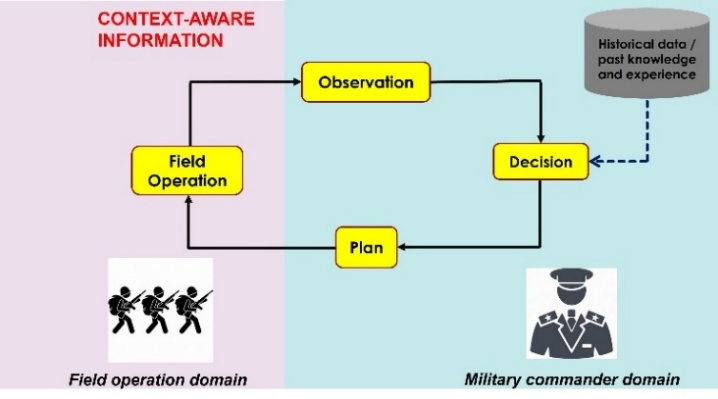
An area of application where CMSs could find fertile ground is military healthcare and field operations, as military commanders and others responsible for the battlefield can base their decisions on information from all sources available to them at the relevant time [4]. More in detail, Fig. 1 shows the usual decision-making cycle followed in the military healthcare domain. The whole cycle consists of an interaction between the operation field domain and the military commander domain. Military commanders collect contextual information on the operation field domain. This real-time collection of data, together with historical data and previous experiences, constitutes the information to be analyzed by the commanders. The analysis results in the commander’s decision on the most appropriate action to be applied to the operation field domain [5]. During the decision-making process, commanders consider specific goals and policies, as well as past knowledge and experience derived from previous interactions with field operations that have similar physical and environmental characteristics; thus, the whole process can be reflected as a closed loop [6].
As depicted in Fig. 1, the basic motivation behind the cognitive-based decision-making cycle in the military healthcare domain has to do with the fact that commanders could be significantly facilitated by an intelligent system that keeps track of past actions, stores information in a knowledge database, and provides this information as input prior to decision making. At another level, CMSs may cater for fast and effective adaptations of the communication infrastructure to changing requirements, and thus guarantee unobtrusive communication during critical situations [7].
Novel management functionalities, enhanced with cognitive networking capabilities, may be needed for military healthcare in field operations to provide faster transmissions as well as higher reliability and availability. Such cognitive systems are most critical in battle environments for providing efficient strategic decisions and greater personalization of field operations. Before CMSs can be deployed in military healthcare applications, they need to be trained through data generated from operational activities, so that they can learn similar groups of subjects and associations between subject features and outcomes of interest [8].
CMS trainings are based mainly on machine learning (ML) techniques, where data-analytical algorithms can extract features from data [9–11]. With respect to military healthcare, inputs to ML algorithms include field operation traits and sometimes combat outcomes of interest [9–11].
III. METHODOLOGY
This section presents in detail the context in which an intelligent management platform for the health monitoring of soldiers in a military operational field—namely ‘i-SHM’—is envisaged to operate.
As mentioned previously, the manner in which military commanders remain engaged with the battlefield and monitor the soldiers—as well as how the central system receives data associated with the soldier’s health status and environment—can change from time to time. Thus, a cognitive management functionality is required in order to adapt, in real time, the soldier’s level of health status due to changes in associated variables of interest [12].
In this respect, the proposed ‘i-SHM’ functionality is aimed to interact, on behalf of the commander/user, with all the available levels of health status, making intelligent health predictions by taking into account the commander’s/user’s request, the available set of input features/parameters, the policies, and previous knowledge. Communication among the commander/user and the proposed ‘i-SHM’ functionality can be performed through a well-designed interface system [13].
In more detail, ‘i-SHM’ functionality uses as input:
- Historical health data / medical statistics—data on specific medical conditions within the military healthcare context,
- Biological parameters—data relating to the soldier’s body that impact health (e.g., blood pressure, heart rate, ECG rate, body temperature, etc.), and
- Physical environment contextual parameters—actual data associated with environmental aspects in the battlefield (e.g., humidity, weather conditions, dust density, etc.).
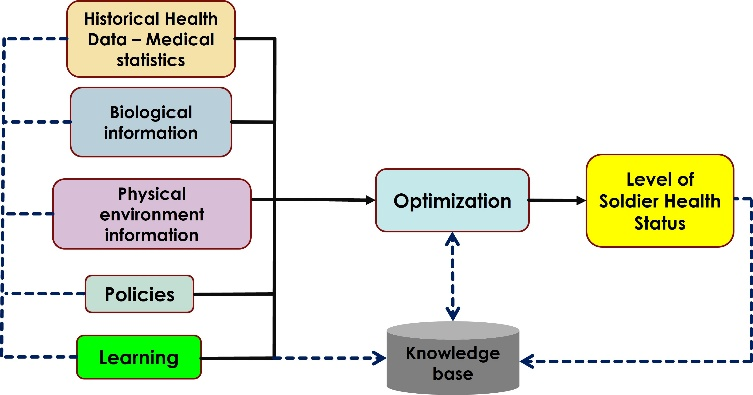
Furthermore, ‘i-SHM’ uses two sets of overarching policies regarding the importance of associated parameters. The first set of policies reflects the commander’s/user’s preferences toward a set of predefined biological parameters. The commander/user specifies the importance attributed to each parameter by assigning a weight value between 0 and 1 (0 = lowest importance, 1 = highest importance). Some biological parameters may share the same weight (e.g., blood pressure and heart rate could be equally important).
The second set of policies, associated with the physical environment contextual parameters, is established by the operator system based on real-time information extracted from infrastructure sensors. Similarly, the operator system attributes each parameter a weight value between 0 and 1. Because environmental parameters can change rapidly, the central operator system may need to adapt their respective weight values frequently.
Based on the above, all combinations of input data (historical health data/medical statistics, physical environment contextual parameters, policies, learning scheme) with related decisions are kept in an appropriately structured database. When a specific input situation is encountered, ‘i-SHM’ first searches the (classified) database to check whether a similar situation has been encountered in the past and how it was tackled. If yes, the algorithm does not need to run; the previous decision—through exploitation of knowledge and experience—is applied again.
Otherwise, ‘i-SHM’ and its algorithm need to run and reach a decision through the process described as follows. Since sensor data fusion systems provide ‘i-SHM’ with input physical environment information continuously, the algorithm needs to run only when something changes—i.e., when the present input situation has not been addressed before. In this respect, parameter changes are adapted to quickly and successfully, valuable time is saved, and the overall complexity of the proposed platform is reduced.
The above methodology presents the theoretical basis of the ‘i-SHM’ functional architecture. As future activities, one could consider implementing and verifying ‘i-SHM’ on a practical basis (dataset examples, system mockups, pilot studies, etc.). Sufficiently large and realistic field tests are necessary, evaluating important performance metrics like computational efficiency and scalability.
IV. CONCLUSIONS
Cognitive computing in military healthcare is a hot and promising topic. Both academia and industry are making significant efforts to improve current systems and propose novel health decision-making solutions. Health predictions within the military healthcare setting are of crucial importance, as they are associated with significantly worse outcomes when unmanaged.
The proposed ‘i-SHM’ is introduced to cognitively manage, quickly and efficiently, the commander’s/user’s request, real-time crucial information associated with the physical environment, historical health data and biological determinants, policies, and previous knowledge turned into experience. This conceptual framework aims to: (a) make more informed health decisions at the point of care within the military healthcare setting; (b) heighten the confidence of military commanders and healthcare professionals by leveraging evidence-based recommendations backed by deep knowledge toward soldier health predictions; and (c) identify the strength of key factors to help make critical decisions toward soldier health predictions that are fast, clinically consistent, and accessible. In this context, ‘i-SHM’ aims to enhance monitoring and tracking of soldiers' health, minimize response time in medical emergencies, and provide immediate care to those who need it.
This work opens the gates to several future areas: (1) interoperation and communication issues among different sources and devices, due to their crucial importance toward effective soldier health predictions; (2) implementation of advanced AI-enabled solutions and cognitive decision-making algorithms in ‘i-SHM’ for making life-critical health decisions and predicting adverse outcomes before they happen, better managing highly complex situations, and ultimately allowing military clinicians to spend less time analyzing data and more time harnessing their experience and human touch in delivering care; and (3) understanding aspects likely to maximize adoption of cognitive health management systems in the military healthcare domain.
REFERENCES
[1] V. Patel, N. Yeware, B. Thombre and A. Chopde, "Soldiers Health Monitoring and Position Tracking System," 2024 IEEE International Students' Conference on Electrical, Electronics and Computer Science (SCEECS), Bhopal, India, 2024, pp. 1–4, doi: 10.1109/SCEECS61402.2024.10482038.
[2] J. J. Kang, "A Military Human Performance Management System Design using Machine Learning Algorithms," 2021 31st International Telecommunication Networks and Applications Conference (ITNAC), Sydney, Australia, 2021, pp. 13–18, doi: 10.1109/ITNAC53136.2021.9652140.
[3] S. Bandopadhaya, R. Dey, and A. Suhag, “Integrated healthcare monitoring solutions for soldier using the Internet of Things with distributed computing,” Sustainable Computing: Informatics and Systems, vol. 26, 2020, 100378, https://doi.org/10.1016/j.suscom.2020.100378.
[4] L. C. Main, L. T. McLoughlin, S. D. Flanagan, M. C. Canino, and S. Banks, “Monitoring cognitive function in the fatigued warfighter: A rapid review of cognitive biomarkers,” Journal of Science and Medicine in Sport, vol. 26, 2023, pp. S54–S63, https://doi.org/10.1016/j.jsams.2023.04.009.
[5] G. Dimitrakopoulos and M. Logothetis, “Intelligent Management Functionality for Emergency Medical Applications Based on Cognitive Networking Principles,” Journal of Software Engineering and Applications, vol. 1, 2011, pp. 23–36.
[6] P. Kumar, G. Rasika, V. Patil, and S. Bobade, "Health Monitoring and Tracking of Soldier Using GPS," International Journal of Research in Advent Technology, vol. 2, no. 4, 2014, pp. 291–294.
[7] S. Sharma, S. Kumar, A. Keshari, S. Ahmed, S. Gupta and A. Suri, "A Real Time Autonomous Soldier Health Monitoring and Reporting System Using COTS Available Entities," 2015 Second International Conference on Advances in Computing and Communication Engineering, Dehradun, India, 2015, pp. 683–687, doi: 10.1109/ICACCE.2015.84.
[8] A. Muqeet, Mohd & Q. Mohammed, "An IoT based patient monitoring system using Raspberry Pi", International Conference on Computing Technologies and Intelligent Data Engineering, Kovilpatti, India, Jan. 2016, pp. 1–4.
[9] D. Kumar and S. Repal, "Real Time Tracking and Health Monitoring of Soldiers Using ZigBee Technology: A Survey", International Journal of Innovative Research in Science, Engineering, and Technology, vol. 4, no. 7, July 2015, pp. 5561–5574.
[10] G. Raj and S. Banu, "GPS Based Soldier Tracking and Health Indication System with Environmental Analysis," International Journal of Enhanced Research in Science, Technology, and Engineering, vol. 2, no. 12, Dec. 2013, pp. 46–52.
[11] S. Roy, T. Meena, and S. J. Lim, “Demystifying Supervised Learning in Healthcare 4.0: A New Reality of Transforming Diagnostic Medicine,” Diagnostics, vol. 12, no. 10, 2022, https://doi.org/10.3390/diagnostics12102549.
[12] M. S. Jassas, A. A. Qasem and Q. H. Mahmoud, "A smart system connecting e-health sensors and the cloud," 2015 IEEE 28th Canadian Conference on Electrical and Computer Engineering (CCECE), Halifax, NS, Canada, 2015, pp. 712–716, doi: 10.1109/CCECE.2015.7129362.
[13] A. Gondalia, D. Dixit, S. Parashar, V. Raghava, A. Sengupta, V. Raja Sarobin, “IoT-based Healthcare Monitoring System for War Soldiers using Machine Learning,” Procedia Computer Science, vol. 133, 2018, pp. 1005–1013, https://doi.org/10.1016/j.procs.2018.07.075.