Article
An Efficient Artificial Intelligence Model for Identifying Crop Types Compatible with Soil and Climate
Nowadays, determining crop types compatible with soil and climate is a major dilemma in agriculture. Artificial intelligence algorithms are transforming agriculture by improving efficiency, sustainability, and productivity. A hybrid model which is called an efficient artificial intelligence model for Identifying Crop Types compatible with Soil and Climate (ICTSC) is proposed to integrate two principal models where the random forest model classifies crops based on soil characteristics and nutrient levels, and also the XGBoost analyzes climate data and predict future weather conditions.
Keywords: ICTSC, Crops, Agricultural, Machine Learning, Deep Learning.
I. INTRODUCTION
Selecting crop types compatible with soil and climate is a foundational aspect of sustainable and productive agriculture. The importance of determining crop types comes to the strategic alignment of crop species with specific soil characteristics, such as pH levels, texture, composition, and fertility, and climatic conditions, including temperature, rainfall patterns, and humidity levels. Ensuring compatibility between crops and their environmental conditions not only enhances yield and crop quality but also significantly reduces reliance on chemical inputs such as fertilizers and pesticides. Therefore, alignment supports long-term agricultural sustainability by improving resource efficiency and minimizing environmental degradation [1]. Furthermore, emphasized that cultivating crops under optimal conditions leads to better resilience, higher profitability, and reduced ecological impact.
Agriculture is essential for food security and supports the national economy in nations where it serves as a primary income-generating sector. The agricultural sector faces numerous challenges, including climate change, soil degradation, and water constraint. According to the food and agriculture organization climate change is adversely affecting crop productivity particularly due to the antiquated farming practices common in traditional agricultural regions.
The study aims to integrate new technology to fulfill sustainable development objectives, while establishing practical frameworks to assist the agricultural community in the region here the used models will improve the management of natural resources and foster a sustainable agricultural sector [2].
II. PRELIMINARY
Access to data on current soils and prevailing weather conditions is essential for determining suitable crops and predicting yields of existing crops. Depending on the temperature and soil conditions that are required for farming, different crops can be grown. It is possible for machine learning and deep learning algorithms to examine crop features, weather conditions, and soil types, which may then result in accurate predictions that can aid in determining suitable crops and the best times to sow or harvest them. It has been widely agreed in a variety of agricultural industries that artificial intelligence should be included into concerns pertaining to crop development and yields [3].
A study have been conducted in [4] aimed to examine the application of AI models in modern agriculture as a key driver of innovation in the sector. Utilizing a quantitative research approach data were collected from a sample of agricultural technology firms and AI specialists to assess the effectiveness of AI-driven solutions. The study population comprised professionals and organizations involved in digital agriculture.
A study aims to investigate the application of machine learning, deep learning, and time series analysis in modern agriculture to address sustainability challenges [7] where PRISMA methodology, a systematic literature review was conducted to explore the roles of ML and DL in optimizing agricultural processes such as crop selection, yield prediction, soil compatibility classification, and water management. The study population includes previous research and scholarly articles related to smart farming and AI applications in agriculture with the sample consisting of relevant studies selected based on predefined inclusion criteria.
The most significant finding highlights how ML algorithms contribute to soil fertility classification and crop selection while DL techniques enhance forecasting capabilities for crop production and commodity prices. The primary recommendation emphasizes the need for increased adoption and integration of AI-driven techniques in agriculture to improve decision-making, optimize resource utilization, and address global food security challenges [7].
Examining the role of advanced technologies including IoT remote sensing and AI in enhancing sustainable forest management practices have been conducted in [5]. Through a systematic review of 196 studies published between 2021 and 2024 from various academic databases, the research highlighted how IoT devices such as drones enable real-time data collection on environmental factors supporting continuous forest monitoring. Additionally, remote sensing technologies provide high-resolution satellite imagery for large-scale forest assessments, including biomass estimation and illegal logging detection. The integration of AI further enhances predictive modeling and decision-making, improving forest conservation efforts.
A high level of prediction accuracy (99%) may be achieved with the utilization of Random Forest, while Internet of Things protocols such as MQTT guarantee effective cloud connectivity. An increase in its practical application for farmers is achieved with the addition of weather predictions. But it has a limitation in that it focuses mostly on physical and virtual data, but it does not take consideration any past soil data or habits that are special to farmers. Because it is restricted to a suburban area in Cameroon, its applicability to other locations that have different agricultural circumstances may be limited as a result of this limitation [X8].
III. THE ICTSC METHODOLOGY
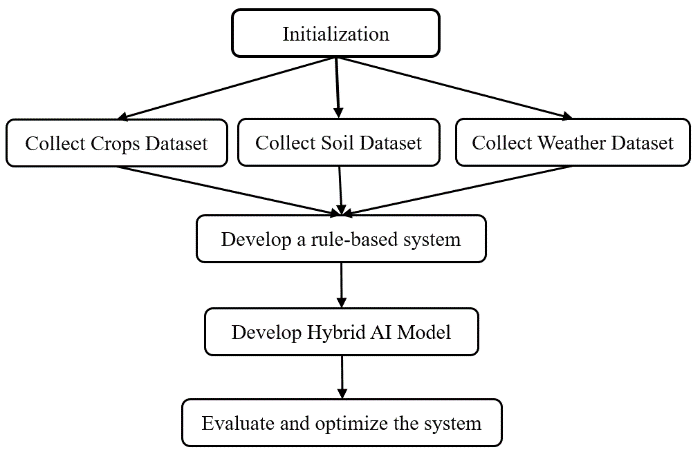
A hybrid model which is called an efficient artificial intelligence model for Identifying Crop Types compatible with Soil and Climate (ICTSC) is proposed to integrate two principal models where the random forest model classifies crops based on soil characteristics and nutrient levels. The overarching technique for the development of the proposed system is depicted in Fig. 1.
Fig. 1: The methodology of the proposed system
The models are proposed to be used as follows:
The XGBoost model was chosen to predict future climatic conditions where it analyzes climate data and predict future weather conditions due to its efficiency in handling time-series data and its interpretability [8]. The XGBoost algorithm is based on the principle of gradient boosting, where the predictive model is built through a series of weak learners that improve gradually. Subsequently, equation (1) is used in the algorithm as follows:
ŷ
i = ∑
k=1K f
k(x
i), f
k ∈ F ….. (1)
The Random Forest model is chosen for its efficiency where it classifies crops based on soil properties and nutrients in handling multi-class data and its ability to achieve a good balance between accuracy and interpretability of results. The model relies on soil properties and nutrient elements to determine the most suitable crop for each agricultural environment [6]. The final classification is calculated through equation (2).
ŷ = mode{h
1(x), h
2(x), … , h
n(x)} …… (2)
The proposed ICTSC framework consists of several steps as follows where the output of each step is an input for next as Figure 1 shows:
- Collecting data from the selected trusted sources upon the target soil and location.
- Processing and preparing data to ensure its quality and relevance depending on robust rules.
- Training the models using machine learning approaches.
- Evaluating the performance of ICTSC model to ensure accuracy of the output results.
- Providing accurate results through a friendly and interactive user interface.
IV. IMPORTANCE OF DEPTI
The agricultural sector has challenges including as soil erosion, water scarcity, and erratic weather patterns, which adversely affect crop yields and total agricultural productivity. The issues can be encapsulated as follows:
- An efficient artificial intelligence system for forecasting, managing agricultural activities, and evaluating soil and climatic data is lacking.
- Insufficient practical guidance on selecting appropriate crops for specific soil types and climatic conditions throughout the year.
- The necessity to evaluate the efficacy of artificial intelligence-based technologies in relation to conventional farming practices in the region.
As a proposed solution the following can be the work way to overcome the above mentioned points:
- AI Models for Analyzing Soil and Meteorological Data
- Recommend planting timelines, irrigation methods, and crop choices.
- Assess the efficacy of AI-driven methodologies in comparison to traditional agricultural practices.
V. EXPECTED RESULTS
The AI model is anticipated to deliver accurate suggestions for the most suitable crops for particular soil and climatic conditions.
- Recommend ideal planting periods to enhance productivity and reduce resource consumption.
- Provide insights on how AI-driven solutions might enhance sustainability in contrast to conventional farming practices.
VI. CONCLUSION
The proposed ICTSC in predicting weather conditions and identifying suitable crops for different soil characteristics. Two models are also proposed to be included in ICTSC which are XGBoost and Random Forest to get high accuracy in crop classification. Key challenges such as data imbalance and limited climatic data were addressed using advanced data processing and feature engineering techniques.
The ICTSC expected to be valuable tool for farmers and decision-makers in the agricultural sector, contributing to enhanced agricultural productivity, resource use efficiency, and more sustainable decision-making.
REFERENCES
[1] Ray, S., Maitra, Sairam, M., Sameer, S., Sagar, I., Divya, S., & Gitari, I. 2025. The nexus between intercropping systems, ecosystem services and sustainable agriculture: A review. Res Crop, 26(1).
[2] E. M. Karunathilake, A. T. Le, S. Heo, Y. S. Chung, and S. Mansoor, 2023, “The Path to Smart Farming: Innovations and Opportunities in Precision Agriculture,” Agriculture, 13(8), 1593.
[3] N. Erlin, A. Yunianta, L. A. Wulandhari, Y. Desnelita, N. Nasution, and N. Junadhi, 2024, “Enhancing Rice Production Prediction in Indonesia Using Advanced Machine Learning Models,” IEEE Access, p. 1.
[4] Anokhina, O., Musaeva, M., & Grace, A. (2025). Engineering and technological aspects of the application of artificial intelligence models in modern agriculture. In ITM Web of Conferences Vol. 72, p. 03004.
[5] Ali, G., Mijwil, M. M., Adamopoulos, I., & Ayad, J. (2025). Leveraging the Internet of Things, Remote Sensing, and Artificial Intelligence for Sustainable Forest Management. Babylonian Journal of Internet of Things, p:1-65.
[6] Rahman, M. M., Islam, M. S., & Hasan, M. A., 2023. Soil Classification and Crop Recommendation Using Machine Learning: A Case Study in Bangladesh. Journal of the Saudi Society of Agricultural Sciences, 22(1), 13-24.
[7] Ali, Z., Muhammad, A., Lee, N., Waqar, M., & Lee, S. W. (2025). Artificial Intelligence for Sustainable Agriculture: A Comprehensive Review of AI-Driven Technologies in Crop Production. Sustainability, 17(5), 2281.
[8] García-Martínez, H., López-Morales, V., & Rodríguez-Hernández, M. 2023. Aplicación de XGBoost en la predicción de condiciones climáticas para la agricultura de precisión. Revista Mexicana de Ciencias Agrícolas, 14(3), 567-582.