This paper reviews how Artificial Intelligence (AI) is used in personalized medicine through predictive analysis of genomic data. A thematic literature review of ten academic studies was conducted to examine the use of AI models in disease risk prediction, ethical challenges, and the limitations of existing models trained primarily on Western genomic data. The findings highlight the lack of UAE-specific genomic research and raise concerns about fairness and accuracy of models in local clinical settings. This paper identifies the research gaps and proposes future directions to improve the utilization of AI models in personalized medicine by leveraging the UAE Genome Program.
Keywords: Artificial Intelligence, Predictive Analysis, Personalized Medicine, Genomic Data, Deep Learning, Machine Learning.
I. INTRODUCTION
Predictive analytics and Artificial Intelligence are transforming genetic testing in healthcare. Machine learning—especially deep learning models—can analyse massive amounts of genomic data to improve disease detection, risk assessment, and personalized treatment. However, the effectiveness of these models heavily relies on the representation and quality of the training data, which often excludes non-Western populations.
A. Background and Motivation
UAE is one of the leading countries investing in genomic research to address the growing number of chronic diseases and rare genetic conditions. The UAE Genome Program aims to improve genomic healthcare by mapping the genetic makeup of the local population. This initiative creates opportunities for using AI to support personalized medicine. However, as genomic data grows, the need to develop AI models tailored to the Emirati population becomes urgent for effective healthcare service delivery.
B. Problem Statement
The real-world application of AI and predictive analytics in genomic medicine in the UAE remains limited. This is mainly because current AI models are developed using non-representative datasets, primarily from Western populations. These models may produce biased or inaccurate results for the UAE’s diverse population. Challenges around the explainability of AI outputs, ethical governance, and local clinical integration limit the adoption of AI-driven personalized medicine in the region.
C. Aims and Objectives
This study aims to:
- Review the current use of AI and predictive analysis in personalized medicine with a focus on genomic data.
- Highlight research gaps in the applicability of AI models trained on Western-specific datasets to the UAE context.
- Propose future directions to enhance model accuracy, transparency, and ethical governance within genomic healthcare systems.
D. Research Questions
RQ1: How are AI and predictive analytics currently being used in personalized genomic medicine?
RQ2: What are the limitations of applying Western-trained AI models in the UAE?
RQ3: What ethical and regulatory challenges must be addressed to support local implementation?
E. Contributions
This paper conducts a thematic literature review of AI applications in personalized genomic medicine, identifies critical gaps related to region-specific data and ethical considerations, and recommends pathways for developing more inclusive and effective AI models for the UAE healthcare system.
F. Structure of the paper
The paper presents the methodology, summarizes key themes from literature, outlines results and research gaps, proposes future research directions, and concludes with recommendations for advancing AI in personalized medicine in the UAE.
II. METHODOLOGY
This study follows a qualitative thematic literature review approach to explore the application of AI and predictive analysis in personalized genomic medicine, with a specific focus on the UAE context. A total of ten peer-reviewed articles published between 2022 and 2024 were selected from reputable journals using academic databases such as PubMed, Scopus, and Google Scholar.
The paper selection criteria included studies that applied AI or predictive analysis to genomic data; studies relevant to disease prediction, personalized medicine, or ethical concerns; and English-language articles. Studies focused on technical model development without healthcare application or unrelated to genomics were excluded.
Selected papers were thematically coded and grouped into four key themes: Predictive Analytics and AI in Genomic Healthcare, Deep Learning and Machine Learning Models, Ethical and Regulatory Challenges in Genomic AI, and Genomic Research including the UAE Genome Program.
Table 1 summarizes the key characteristics of the selected studies, including study type, findings/limitations, and their relevance to personalized medicine.
III. LITERATURE REVIEW
A. Predictive Analytics and AI in Genomic Healthcare
Predictive analytics and AI create opportunities in genomics to enhance prediction of disease risk and personalized medications. Challenges arise from variations in methodologies and data sources. One major challenge is the generalizability of AI models, in addition to limited clinical settings to apply these models.
Zhang et al. [10] and Hassan et al. [4] investigate how predictive analysis and AI models enhance disease risk assessment using genetic data but in different ways. Zhang et al. [10] concentrate on big-data analysis and show that next-generation sequencing (NGS) has an important role in enhancing rare-disease predictions; whereas Hassan et al. [4] focus on improving personalized medicine by integrating biomedical, transcriptomic, and clinical data.
Both studies highlight the role of predictive analysis and AI in disease risk assessment, but their shortcomings reveal critical research gaps. Zhang et al. [10] face bias in datasets and rely on Western-centric genomic data, limiting generalizability to non-Western populations. Hassan et al. [4] underscore the absence of frameworks regulating the integration of genetic AI models into clinics, creating data-privacy concerns.
A third study by Khan, Mohsen, and Shah [5] relates closely to these works through a systematic review focused on genetic biomarkers for predicting diabetes. Their findings show that AI improves diabetes risk assessment and that multimodal prediction models perform better than unimodal models; however, overfitting from small sample sizes is a limitation.
B. Deep Learning and Machine Learning Models
Multiple studies examine the role of deep learning in genomic medicine. Quazi [6] observes how CNNs, GANs, and traditional ML models can improve genomic analysis via a comparative study; deep learning models outperform traditional ML in detecting mutations and analysing genome sequences.
Alzoubi et al. [1] propose a deep learning framework to predict disease risks using GWAS datasets and report 94% accuracy in identifying complex genetic disorders. Both Quazi [6] and Alzoubi et al. [1] affirm high performance but underline black-box limitations and lack of explainability.
Vilhekar & Rawekar [8] examine deep and machine learning across drug repurposing and disease detection. They underline strengths in personalized diagnosis and treatment, yet highlight transparency and validation shortcomings. Choon et al. [3] explore AI/Deep-Learning databases aiding NGS-based rare-disease diagnosis. Zhang & Imoto [9] convert genetic sequences into images for variant classification. Both emphasize the potential of AI in genomics but lack UAE Genome Program training data.
C. Ethical and Regulatory Challenges in Genomic AI
Privacy concerns, public trust, biased datasets/models, and lack of regulations limit implementation despite potential. Rahma et al. [7] examine public perception of AI genetic testing in the UAE using a cross-sectional survey and find that lack of trust and fear of misuse of private information hinder adoption. Ateia et al. [2] focus on regulatory challenges and policies for data sharing in regional genome programs, highlighting the need for governance frameworks; they note the Emirati Genome Program aligns with high ethical and governance standards and keeps participant data anonymous.
D. Genomic Research including UAE Genome Program
Most genetics AI models are trained and validated on Western-centric datasets, limiting applicability to non-Western populations. To address this, the UAE Genome Program develops AI models trained on UAE-specific genetic data. Atieh et al. [2] highlight UAE Genome Program objectives to improve predictive medicine using AI, while Rahma et al. [7] explore public attitudes. Both underline the need for UAE-trained models to improve accuracy, trust, and fairness.
IV. RESULTS
The review of ten recent studies revealed the following key insights (Fig. 1 illustrates the main themes identified across the reviewed studies):
- AI models—especially deep learning—are effective in disease prediction using genetic data.
- Deep learning models outperform traditional ML in pattern discovery but are difficult to interpret in clinical settings.
- Privacy concerns and potential misuse of genetic data are widely cited; policies and regulations are still evolving.
- None of the reviewed studies applied data from the UAE Genome Program.
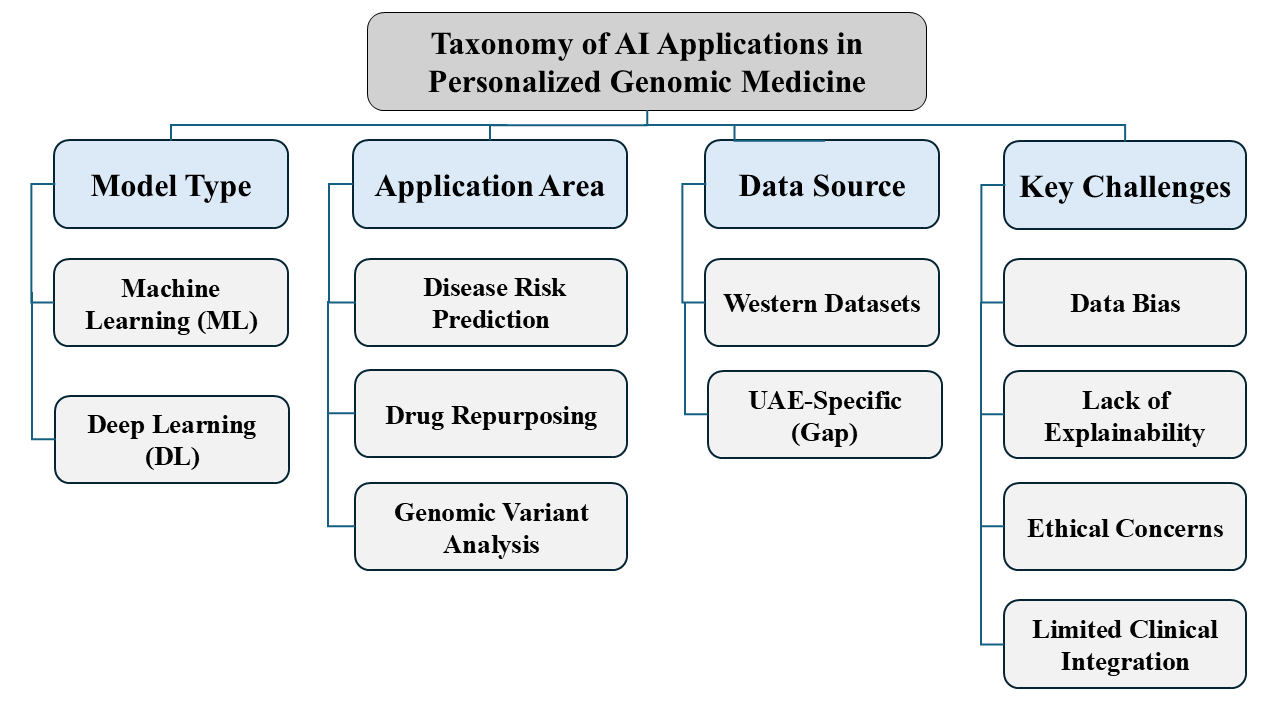
Fig. 1. Taxonomy of AI applications in personalized genomic medicine.
V. RESEARCH GAPS
The literature review found multiple gaps within the UAE context:
- Most AI models are trained on Western-centric datasets, limiting their fit to UAE population data and reducing local clinical applicability.
- Deep learning models function as unexplainable black boxes, impeding integration into clinical processes and clinician trust.
- Lack of clear policies and regulatory frameworks for AI use in genomic healthcare leads to ethical concerns and public mistrust regarding data misuse.
VI. RESEARCH DIRECTIONS
To build reliable and effective AI-based genomic healthcare in the UAE:
First, train AI models using Emirati genomic data to improve prediction accuracy and local relevance.
Second, integrate Explainable AI (XAI) into predictive models to improve transparency and build trust among clinicians and patients.
Third, develop a governance framework for AI in genomic medicine that addresses data privacy, patient consent, and model authorization to ensure ethical implementation and public trust.
Finally, close the gap between research and clinical practice by conducting pilot studies and clinical trials with hospitals to validate AI applications in real-world settings.
VII. CONCLUSION
AI and predictive analysis are transforming personalized medicine by enabling more accurate health-risk prediction using genomic data. However, most AI models are trained on datasets not specific to the UAE population. Key challenges include data bias, ethical concerns, limited model explainability, and lack of clinical integration. There is an urgent need for UAE-trained AI models, explainable methods, and clear regulations. Future work should prioritize local datasets, clinical validation through pilot studies, and transparent, ethical implementation to improve accuracy and trust in genomic AI across the UAE healthcare system.
REFERENCES
[1] Alzoubi, H., Alzubi, R., & Ramzan, N. (2023). Deep Learning Framework for Complex Disease Risk Prediction Using Genomic Variations. Sensors, 23(9), 4439. https://doi.org/10.3390/s23094439
[2] Ateia, M., Ogrodzki, P., Wilson, A., Ganesan, S., Halwani, R., Koshy, S., & Zaher, S. (2023). Population Genome Programs across the Middle East: Landscape, Challenges, and Opportunities. Biomed Hub, 8, 60–71. https://doi.org/10.1159/000530619
[3] Choon, Y. W., Choon, Y. F., Nasarudin, N. A., Al Jasmi, F., Remli, M. A., Alkayali, M. H., & Mohamad, M. S. (2024). Artificial intelligence and database for NGS-based diagnosis in rare disease. Frontiers in Genetics, 14, 1258083. https://doi.org/10.3389/fgene.2023.1258083
[4] Hassan, M., Awan, F. M., Naz, A., deAndrés-Galiana, E. J., Alvarez, O., Cernea, A., Fernández-Brillet, L., Fernández-Martínez, J. L., & Kloczkowski, A. (2022). Innovations in Genomics and Big Data Analytics for Personalized Medicine and Health Care: A Review. International Journal of Molecular Sciences, 23(9), 4645. https://doi.org/10.3390/ijms23094645
[5] Khan, S., Mohsen, F., & Shah, Z. (2024). Genetic biomarkers and machine learning techniques for predicting the onset and progression of diabetes mellitus: a scoping review. Cardiovascular Diabetology, 23(1), 80. https://doi.org/10.1186/s12933-024-02140-8
[6] Quazi, S. (2022). Artificial intelligence and machine learning in precision and genomic medicine. Medical Oncology, 39(8), 120. https://doi.org/10.1007/s12032-022-01711-1
[7] Rahma, A. T., Elhassan, I., Al Anouti, F., Ahmed, S. A., Ali, A., El Gamal, M., AbdelWareth, L. O., Bawazir, A., Elamin, M. A., Mahboub, B., & Tayoun, A. (2023). Knowledge, attitudes, and perceptions of genomic medicine among the general population in the United Arab Emirates. Human Genomics, 17(1), 63. https://doi.org/10.1186/s40246-023-00509-0
[8] Vilhekar, R. S., & Rawekar, A. (2024). Artificial Intelligence in Genetics. Cureus, 16(1), e52035. https://doi.org/10.7759/cureus.52035
[9] Zhang, Y. Z., & Imoto, S. (2024). Genome analysis through image processing with deep learning models. Journal of Human Genetics, 69(10), 519–525. https://doi.org/10.1038/s10038-024-01275-0
[10] Zhang, Y., Yu, J., Xie, X., Jiang, F., & Wu, C. (2024). Application of Genomic Data in Translational Medicine During the Big Data Era. Frontiers in Bioscience (Landmark Edition), 29(1), 7. https://doi.org/10.31083/j.fbl2901007