Article
AI Integrated Approach to Achieve Transformational Strategic Leadership and Its Reflections on Employee Engagement
Integrating Artificial Intelligence (AI) into leadership practices redefines how transformational strategic leadership is enacted across organizations. As industries shift toward digital and data-driven operations, leaders are expected to harness AI to improve communication, drive performance, and increase employee engagement. This paper examines how AI technologies influence strategic leadership, particularly within transformational and emotionally intelligent leadership styles. Drawing from recent literature and empirical insights, this research explores how AI contributes to a more engaged workforce and proposes actionable pathways for aligning digital transformation with human-centric leadership models.
Keywords: Artificial Intelligence, Transformational Strategic Leadership, Employee Engagement, Leadership Reflections.
I. INTRODUCTION
Leaders possess qualities that distinguish them from managers, but they also perform similar "managerial" tasks, including setting goals and developing strategic plans to achieve them, communicating direction to organizational members, monitoring performance, and motivating employees.
All leaders, regardless of their position, engage in the core roles and activities identified by the four-factor theory of leadership proposed by Bowers and Seashore: support through leadership behaviors that enhance subordinates' sense of personal value and importance; facilitating interaction through behaviors that encourage organizational members to build strong, mutually satisfying relationships; focusing on the goal through behaviors that motivate organizational members to achieve outstanding performance and accomplish the organization's stated goals; and facilitating work through behaviors that support the achievement of organizational performance goals, such as coordination, planning, and scheduling, and providing subordinates with the tools, materials, and technical knowledge necessary to perform their tasks.
Furthermore, leadership roles and the focus of a leader's activities vary depending on their position within the organizational structure, as well as other factors such as the type of activity the organization engages in, the surrounding environmental conditions, the organization's stage of development, the leader's role in establishing it, and the scope of its global business activities. All of these factors influence the leader's role and the behaviors required to be an effective leader. Today, AI-enhanced leadership in the era of rapidly evolving digital technology has become crucial for organizations and institutions across the world. Leadership involves the ability to use technology, data, and innovation to reach organizational goals and enhance performance.
Rapid technological change remains one of the biggest challenges for leadership, especially at the strategic level. Digital leaders need to keep pace with new technologies, manage large datasets, and build a digital culture that supports transformation. AI offers both opportunities and drawbacks for leadership roles. With AI tools, leaders can analyze data, forecast trends, and make strategic decisions more effectively; AI can also enhance collaboration via collaborative software and virtual platforms that enable remote teams to share information and ideas. Technology and innovation are not only tools but also a culture and methodology that reflect leaders’ vision, values, and goals, helping enhance organizational culture and achieve sustainable success.
AI is significantly impacting modern leadership styles. As technology advances, the ways leaders and subordinates communicate and interact are changing, and methods of innovation and collaboration at work are evolving. There is a need to understand how AI-integrated leadership produces work environments that boost work interest and employee self-esteem, and promote participation toward organizational goals. Leaders must determine methods to combine AI investments for better organizational results with human-led approaches for building trust, employee motivation, and performance enhancement.
Based on this, the study aims to answer the following key questions: 1) How does AI integration influence leaders' ability to engage and inspire their team members? 2) In which ways can AI tools support emotionally intelligent leadership behaviors? 3) What are the ethical and operational challenges leaders face when using AI to enhance employee engagement? 4) How can organizations balance automation and empathy to maintain a human-centric leadership approach?
II. LITERATURE REVIEW
The intersection of AI and leadership has become a focal point in recent scholarship. Studies argue that AI-fueled organizational cultures can enhance employee engagement by improving training and communication, and that AI reshapes organizational communication dynamics, strengthening performance and connectivity. Other research highlights the mediating role of transformational leadership in leveraging AI for improved decision-making, combining AI analytics with human judgment for more personalized employee development.
Work on emotional intelligence in AI systems indicates that human-AI interaction can simulate empathetic responses, enhancing leadership communication through sentiment analysis and actionable feedback. Ethical leadership is essential to mitigate negative perceptions such as AI-induced job insecurity, with leadership adaptability key to unlocking AI’s potential in digital transformation. HRM’s role is also emphasized in shifting from mere AI implementation to human-centric adoption.
Further studies suggest AI can deliver customized interventions that meet both workplace objectives and staff needs, and that AI-driven transformation impacts participatory leadership by empowering new strategies for employee involvement. In Industry 4.0 contexts, transformational leadership must adapt—focusing on adaptability, ethics, and resilience—to bolster employee commitment.
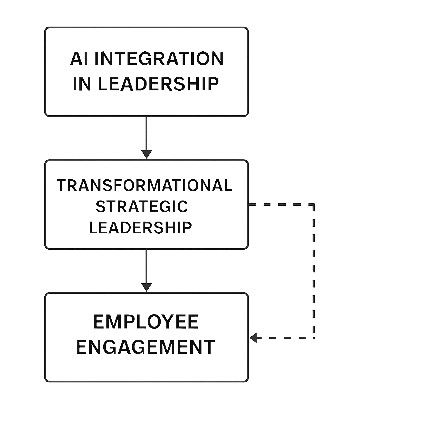
From these insights, the following hypotheses are highlighted: H1: AI integration by leaders positively affects transformational strategic leadership. H2: Transformational strategic leadership produces positive effects leading to enhanced employee engagement. H3: AI integration in leadership positively affects employee engagement. H4: Transformational strategic leadership mediates the relationship between AI integration in leadership and employee engagement.
III. METHODOLOGY
A quantitative research method was implemented to investigate how AI-integrated transformational strategic leadership affects employee engagement in the work environment. Data collection targeted staff members and managers within an organization in the Oil and Gas industry implementing AI in leadership systems. The instrument comprised 15 questions measuring transformational leadership, employee engagement, and the scope of AI implementation within leadership practices.
Stratified random sampling ensured representation across sectors, organizational sizes, and roles. A total of 150 individuals participated, including 20 in leadership/managerial positions. The study received approval from the university’s internal research committee. Due to organizational privacy policies and confidentiality agreements, the data are not publicly available.
The research data were organized using descriptive statistics to report participant demographics along with the study variables.
Figure 1: Conceptual Framework
IV. RESULTS AND DISCUSSION
The study results can be summarized as follows:
Descriptive analysis for the survey items (n=150)
| Section | Mean | SD |
|---|
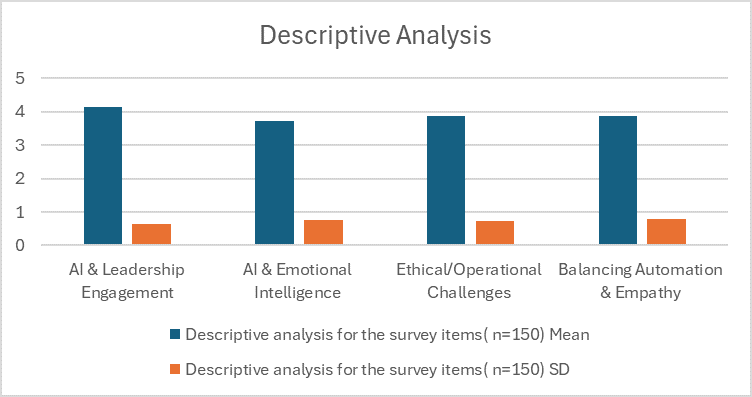
| AI & Leadership Engagement (Items 1–4) | 4.15 | 0.65 |
| AI & Emotional Intelligence (Items 5–8) | 3.73 | 0.75 |
| Ethical/Operational Challenges (Items 9–12) | 3.88 | 0.73 |
| Balancing Automation & Empathy (Items 13–15) | 3.87 | 0.80 |
Table 1: Descriptive Statistics
Leaders view AI as beneficial for emotional-intelligence development, though this area remains under development. Ethical and privacy concerns persist, with many leaders acknowledging limited knowledge of AI ethics. Respondents supported the view that automation can enhance (rather than eliminate) empathy and foresaw strategic advancement with AI. Overall, AI is widely accepted as improving leadership effectiveness and employee engagement; however, ethical training requires improvement and leadership must remain human-centered as automation grows.
V. DISCUSSION
The AI-integrated approach to transformational leadership offers numerous opportunities for enhancing employee engagement while introducing complex challenges. Maintaining the human touch in leadership alongside AI’s efficiency and scalability is essential. Transformational leaders using AI must be adaptable, emotionally intelligent, and ethically grounded—motivating and inspiring while leveraging data transparently and with a human-centric focus.
Strategic leadership in this context involves fostering innovation, aligning AI tools with organizational goals, and continuously nurturing trust within the team. The most effective strategies balance data-driven insight with the emotional realities of the workforce, using AI to support—not replace—leaders’ relational responsibilities.
Figure 2: Result Representation
VI. RECOMMENDATIONS
1. Integrate AI into Leadership Development Programs: Incorporate AI literacy into training for managers and team leaders, covering ethical and practical dimensions of AI-enabled decision-making.
2. Develop Emotionally Intelligent AI Interfaces: Work with HR and developers to implement systems capable of detecting emotional cues and providing supportive feedback loops within ethical boundaries.
3. Establish Ethical Frameworks for AI Use: Create transparent policies for how employee data is collected, analyzed, and applied to build trust and encourage acceptance.
4. Foster an Adaptive and Inclusive Culture: Encourage open communication about AI tools, gather employee input, and emphasize augmentation—not replacement—of human roles.
5. Use AI for Continuous Feedback and Recognition: Leverage AI for real-time feedback, recognition, and targeted support interventions to enhance motivation and morale.
VII. CONCLUSION
AI has the potential to transform strategic leadership into a more adaptive, responsive, and emotionally attuned practice. When used ethically and thoughtfully, AI tools can support leaders in creating more engaged, motivated, and productive workforces. However, technology must not eclipse the need for human connection, empathy, and ethical judgment. The future of transformational leadership lies in a synergistic model where AI augments rather than replaces human capabilities, enabling leaders to elevate both performance and people. Organizations that navigate this integration effectively will set new standards for leadership and employee engagement in the digital era.
REFERENCES
[1] M. Rožman, P. Tominc, and B. Milfelner, “Maximizing employee engagement through artificial intelligence organizational culture in the context of leadership and training of employees: Testing linear and non-linear relationships,” Cogent Business & Management, vol. 10, no. 2, 2023. https://doi.org/10.1080/23311975.2023.2248732
[2] N. V. Florea and G. Croitoru, “The impact of artificial intelligence on communication dynamics and performance in organizational leadership,” Administrative Sciences, vol. 15, no. 2, p. 33, 2025. https://doi.org/10.3390/admsci15020033
[3] A. Abositta, W. A. Muri, and A. Berberoğlu, “Influence of artificial intelligence on engineering management decision-making with mediating role of transformational leadership,” Systems, vol. 12, no. 12, p. 570, 2024. https://doi.org/10.3390/systems12120570
[4] H. Vicci, “Emotional intelligence in AI systems: An exploratory review,” IUP Journal of Soft Skills, vol. 18, no. 2, pp. 5–20, 2024.
[5] B. Kim, M. Kim, and J. Lee, “Code green: Ethical leadership’s role in reconciling AI-induced job insecurity with pro-environmental behavior in the digital workplace,” Humanities & Social Sciences Communications, vol. 11, no. 1, p. 1627, 2024. https://doi.org/10.1057/s41599-024-04139-2
[6] A. Sacavém, A. de B. M., J. d. S. Rodrigues, A. Palma-Moreira, H. Belchior-Rocha, and M. Au-Yong-Oliveira, “Leading in the digital age: The role of leadership in organizational digital transformation,” Administrative Sciences, vol. 15, no. 2, p. 43, 2025. https://doi.org/10.3390/admsci15020043
[7] A. Fenwick, G. Molnar, and P. Frangos, “The critical role of HRM in AI-driven digital transformation: A paradigm shift to enable firms to move from AI implementation to human-centric adoption,” Discover Artificial Intelligence, vol. 4, no. 1, p. 34, 2024. https://doi.org/10.1007/s44163-024-00125-4
[8] N. Lakshmikanth, A. S. Raja, A. S. Babu, and T. P. Prasad, “Employee engagement in artificial intelligence-enabled workplaces: Role of digital leadership and organizational culture,” Materials Today: Proceedings, vol. 82, pp. 435–440, 2024.
[9] E. Sarioguz and S. Miser, “Transformational leadership and participatory management in AI-driven organizations,” Journal of Business Management, vol. 40, no. 1, pp. 20–32, 2024.
[10] J. Boudreaux, “Adapting transformational leadership for Industry 4.0: AI’s impact on leadership qualities,” Leadership Quarterly, vol. 35, no. 2, 2024.
[11] T. M. Schneller, “Enhancing partnership quality: Unlocking AI's impact on B2B partnerships,” Ph.D. dissertation, University of Maryland, University College, 2025.
[12] A. Shah, N. Nasir, and A. Shah, “Inclusive design in AI-driven leadership: Implementation and challenges in small businesses,” International Journal of Business Research and Management, vol. 15, no. 1, pp. 19–42, 2024.
[13] R. Paralta, E. Simões, and P. Duarte, “Subjective well-being in organizations: Effects of internal ethical context and ethical leadership,” International Journal of Environmental Research and Public Health, 2023. https://doi.org/10.3390/ijerph20054451